The giant swallowtail (Papilio cresphontes) is widely recognized as the largest butterfly in North America, with a wingspan that can reach about 7 inches.
Across the United States, butterflies bring color to gardens, parks, fields, and wooded trails. Some are tiny enough to overlook, while others have wings broad enough to catch your eye from several feet away. One of the most impressive is the giant swallowtail, a large black butterfly marked with bright yellow bands.
The giant swallowtail lives across much of the United States, especially in the eastern and southern states. Its size, bold pattern, and distinctive flight make it easier to recognize than many smaller butterflies. Still, its wingspan can vary, and other large butterflies may look just as impressive when seen in flight.
If you want to identify the biggest butterfly in North America, start with its wings, color pattern, and overall shape. Learning where it lives and which plants its caterpillars use can also help you find one. This guide covers its size, life cycle, range, look-alikes, and ways to welcome butterflies into a home garden.
Source: alamy.com
Meet the Giant Swallowtail, North America’s Biggest Butterfly
The giant swallowtail is a member of the swallowtail family, Papilionidae. Its scientific name is Papilio cresphontes. It is widely recognized as the largest butterfly native to North America because adults can have a wingspan of about 7 inches.
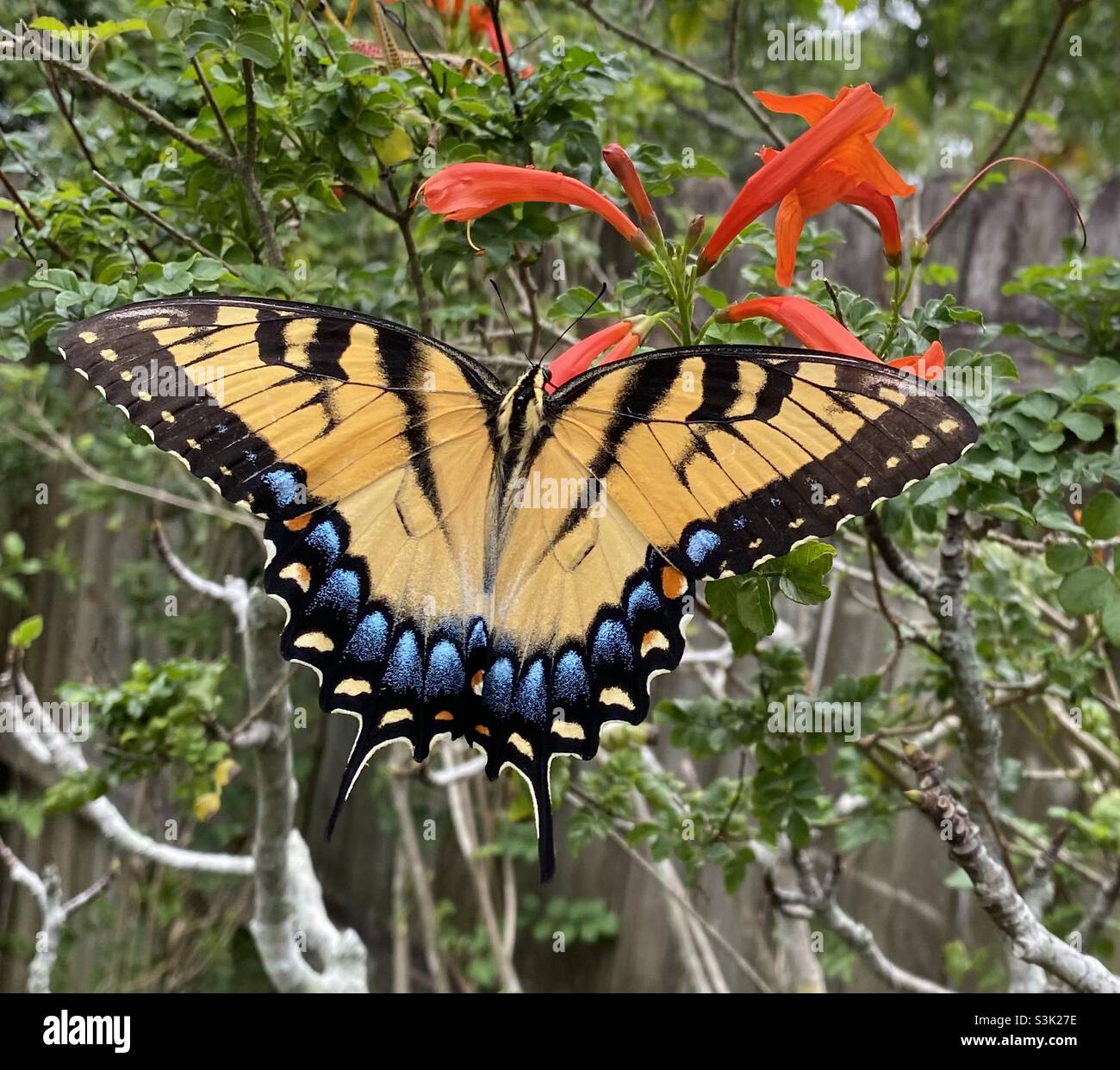
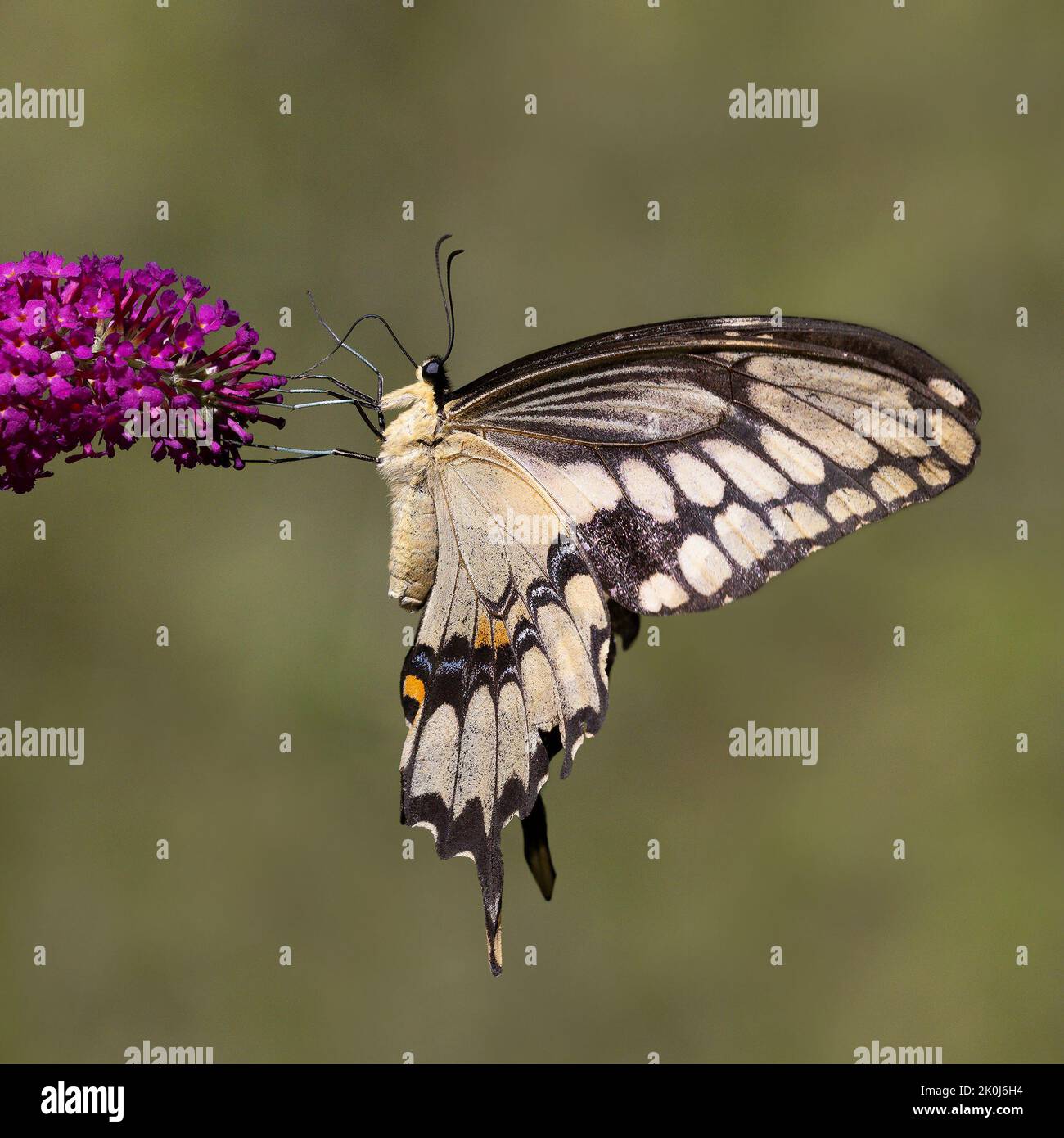
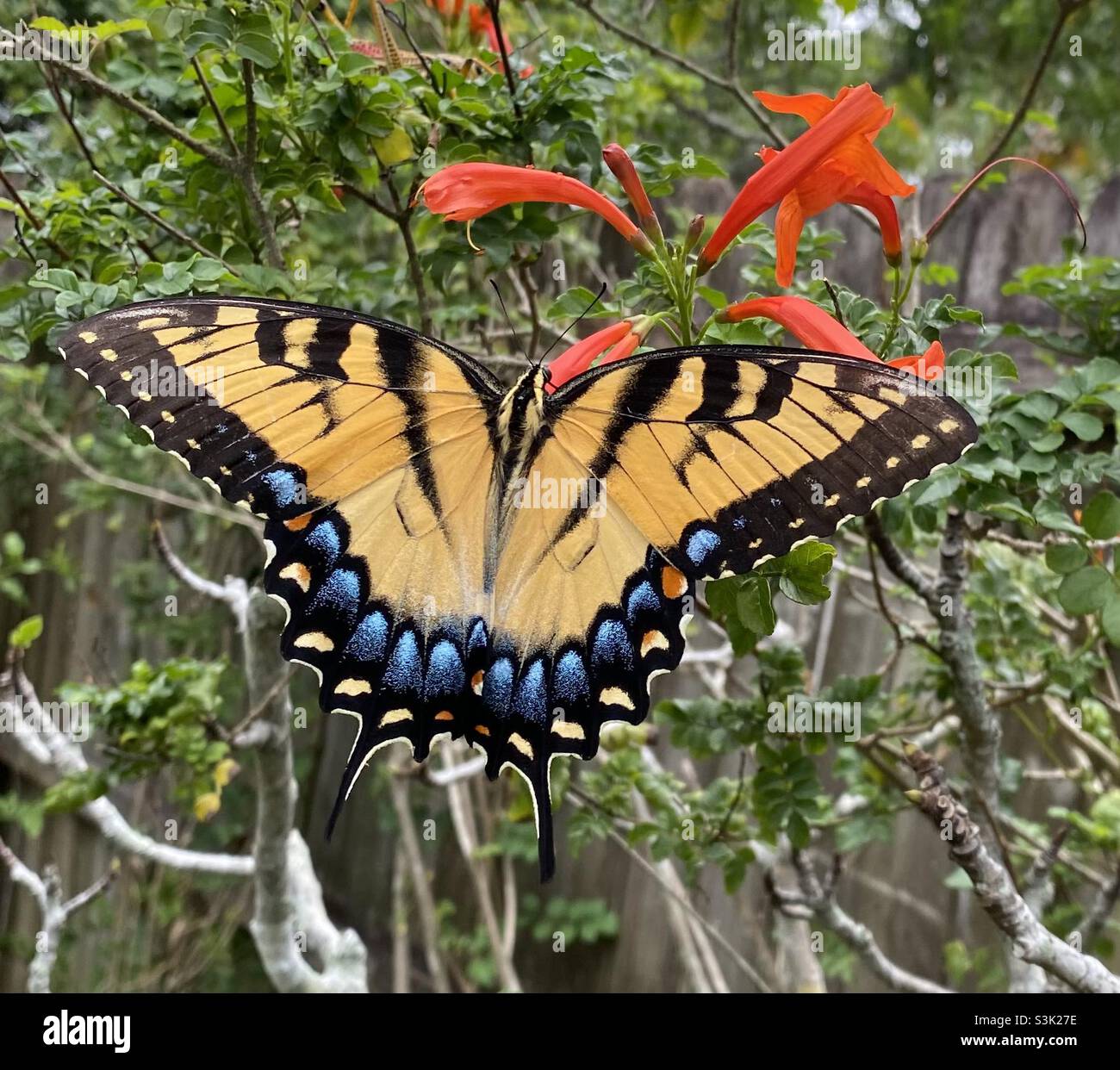
Imagine a dark butterfly gliding over a sunny garden, with yellow markings flashing as it turns. That striking contrast is one of the giant swallowtail’s best clues. Its wings are mostly black or very dark brown, with a broad yellow band across the forewings and yellow markings on the hindwings.
The hindwings also have short, pointed extensions that resemble tails. These extensions help give swallowtails their name. Although the giant swallowtail looks bold, it does not sting, bite people, or pose a threat to pets.
Source: butterfly-lady.com
Common name
Giant swallowtail.
Scientific name
Papilio cresphontes.
Family
Papilionidae, the swallowtail butterfly family.
Maximum wingspan
About 7 inches, with individual butterflies varying in size.
Main field marks
Black wings, yellow bands and spots, and tail-like hindwing extensions.
Why Is It Called a Giant Swallowtail?
The name refers to its large size and the tail-like extensions on its hindwings. These features make it stand out among many other butterflies found in North America. Its broad wings also help it glide between flowers and trees.
The word giant is a useful clue, but it does not mean every adult reaches the largest reported size. Some individuals are much smaller. A butterfly’s wingspan depends on its growth and development, so size should be treated as one part of identification rather than a fixed rule.
Look at the full wing shape
Check for broad wings and short tails on the hindwings.
Look for yellow markings
The yellow bands and spots stand out against the dark wings.
How Big Is the Giant Swallowtail?
A giant swallowtail can have a wingspan of roughly 4 to 7 inches. That range is a helpful field guide estimate, not a promise that every butterfly will fit within the same measurements. Some adults look noticeably larger than others when they open their wings.
Wingspan means the distance from the tip of one fully extended wing to the tip of the other. It is not the length of the body. This distinction matters because a butterfly with a long body may not have the broadest wings, and a wide-winged butterfly can look smaller when its wings are closed.
The giant swallowtail is large enough to stand out among common garden butterflies, but it can still be hard to measure in the wild. It rarely sits still for long with its wings fully open. For a quick identification, use its color pattern and shape rather than trying to estimate an exact measurement.
Source: www.reddit.com
Wingspan
Roughly 4 to 7 inches is a useful general range for the species.
Body length
This is a separate measurement and should not be confused with wingspan.
Visible size
An open-winged butterfly usually looks broader than one resting with its wings upright.
Is It Bigger Than a Monarch?
The giant swallowtail can be larger than a monarch butterfly. Monarch wingspans are commonly around 3.5 to 4 inches, while a giant swallowtail can approach 7 inches. These ranges overlap near their lower and upper ends, so not every giant swallowtail will look dramatically larger than every monarch.
The two species also have very different patterns. Monarchs have orange wings with black veins and white spots along the edges. Giant swallowtails have dark wings crossed by yellow markings. Even when the wings are partly closed, these color differences usually make identification straightforward.
Giant swallowtail
Dark wings with yellow markings and tail-like hindwing extensions.
Monarch
Orange wings with black veins and white spots.
Does the Biggest Butterfly Always Have the Largest Wingspan?
Not every comparison gives the same answer because people may use different regions or measurements. A question about the biggest butterfly in North America may mean the largest species native to the continent, the largest species regularly seen in a particular state, or the individual with the greatest measured wingspan.
The giant swallowtail is a strong answer for the largest native butterfly across North America. However, a local list of large butterflies may include other swallowtails, the two-tailed swallowtail, or the monarch. The species present in a given place can change the comparison.
Species comparison
Use typical wingspan ranges and the same geographic scope.
Record-size comparison
A record individual does not represent the usual size of an entire species.
Where Do Giant Swallowtail Butterflies Live in the United States?
Giant swallowtails occur across much of the eastern and southern United States and extend into parts of the Southwest and other warm regions. They are especially familiar in the Southeast, where host plants and warm weather support their development. Their range also reaches northward into parts of the Midwest and northeastern United States.
You may see one in a backyard garden, a botanical garden, a sunny woodland edge, or a park with flowering plants. Adults move between nectar sources and suitable habitat for breeding. Because the species uses several kinds of host plants, it can live in more than one type of landscape.
The chance of seeing a giant swallowtail depends on location, season, weather, and local plants. A warm state with citrus relatives and nectar flowers may support more sightings than a colder area near the edge of the butterfly’s range. A lack of sightings does not necessarily mean the species is absent.
Source: butterfly-lady.com
Southeast
A major part of its range, including areas with warm weather and suitable host plants.
Southern states
Gardens, parks, and wooded edges can provide food and breeding plants.
Midwest and Northeast
The species occurs in parts of these regions, though local abundance varies.
Southwest
Some areas provide suitable conditions and host plants for the butterfly.
When Is the Best Time to See One?
In much of the United States, warmer months offer the best chance to see adult giant swallowtails. The exact flight season varies with climate and location. In warm southern areas, adults may appear over a longer period than they do farther north.
Choose a sunny day and watch flowering plants in a sheltered garden or park. Butterflies are often easier to spot when they visit flowers for nectar. Midday and afternoon can be productive, but the best time depends on local temperature, wind, and cloud cover.
Pick a calm day
Strong wind can make butterflies harder to observe.
Watch flowering plants
Adult butterflies often pause to feed, giving you a better look.
Check local records
A state butterfly guide or local nature group can help identify the usual flight season.
How to Identify a Giant Swallowtail
The easiest way to identify a giant swallowtail is to look for a large, dark butterfly with a broad yellow band and smaller yellow markings. The wings are usually black or very dark brown. The hindwings have short tails, although these can be hard to see when the butterfly is moving.
A butterfly’s color may appear different under shade, bright sunlight, or a camera flash. Wings can also look worn after days of flight. Use several clues together instead of relying on a single mark or a quick impression of size.
If you take a photograph, try to capture the upper side of the wings and the body. A second image from the side may show the wing shape more clearly. Do not grab the butterfly or hold its wings open to get a better view.
Source: alamy.com
Step 1: Check the base color
Look for black or dark brown wings rather than the bright orange of a monarch.
Step 2: Find the yellow band
A broad yellow band crosses the forewings, with further yellow markings on the hindwings.
Step 3: Look for hindwing tails
The rear wings usually end in short, pointed extensions.
Step 4: Consider the location
Compare the butterfly with species known from your state or region.
Giant Swallowtail vs. Two-Tailed Swallowtail
The two-tailed swallowtail is another large North American butterfly. It is especially associated with the western United States, where it may be seen in canyons, gardens, and other habitats with its host plants. Its wings are yellow with black markings, and each hindwing has two tail-like extensions.
The giant swallowtail has a mostly dark upper wing surface with yellow bands and spots. The two-tailed swallowtail has a more yellow overall appearance. These broad differences are useful when the butterfly is resting, but a clear photograph or a regional field guide can help confirm uncertain sightings.
Giant swallowtail
Mostly dark wings with yellow bands and short tails.
Two-tailed swallowtail
Mostly yellow wings with black markings and two tails on each hindwing.
Giant Swallowtail vs. Monarch
Monarchs have orange wings with black veins and white spots near the edges. Giant swallowtails have a dark background with yellow markings. Their wing shapes differ as well, with the giant swallowtail’s hindwing tails providing another useful clue.
Both species visit flowers, so the type of flower alone cannot confirm an identification. Watch the full pattern and shape, and take a photo if you need time to compare it with a field guide.
Color
Monarchs are orange and black; giant swallowtails are dark with yellow.
Wing edges
Giant swallowtails have noticeable hindwing tails.
The Giant Swallowtail Life Cycle
The giant swallowtail develops through four stages: egg, caterpillar, pupa, and adult butterfly. This process is called complete metamorphosis. Each stage has a different role, from feeding and growth to the final stage that allows the butterfly to mate and lay eggs.
A female lays small eggs on suitable host plants. After hatching, the caterpillar eats plant material and grows through several stages. It later forms a pupa, also called a chrysalis, where its body changes into an adult butterfly.
The timing of these stages varies with temperature, food supply, and location. In warm conditions, development may move faster than in cool weather. A caterpillar that seems to vanish from a plant may have moved to another part of the host plant or entered the next stage.
Source: www.pinterest.com
Eggs and Caterpillars
Giant swallowtail eggs are small and are often laid on leaves or other parts of a suitable host plant. Once a caterpillar hatches, it begins feeding and growing. Young caterpillars can resemble bird droppings, a form of camouflage that may help them avoid predators.
As the caterpillar grows, its appearance changes. Older caterpillars may have a mottled brown and white pattern that looks like bark or a bird dropping. This unusual look can make them difficult to notice, even when they are resting on a leaf in plain sight.
Giant swallowtail caterpillars are sometimes called orange dogs because they can feed on citrus plants. The name may sound odd, but it refers to the caterpillar, not an adult butterfly. Their feeding can matter to people who grow citrus, especially when many caterpillars use the same young plants.
Egg
A small egg is laid on a suitable host plant.
Caterpillar
The larva feeds on leaves and grows through several stages.
Camouflage
Young and older caterpillars can resemble bird droppings or rough plant surfaces.
The Chrysalis and Adult Butterfly
When a caterpillar is ready, it stops feeding and forms a pupa. The chrysalis may blend into its surroundings, which can make it hard to find. Inside, the insect undergoes major changes as it develops into an adult.
The adult butterfly emerges with soft, folded wings. It must pump fluid into the wings and allow them to expand and harden before it can fly well. If you find a newly emerged butterfly, leave it undisturbed and give it space to finish this process.
The adult’s main tasks include feeding on nectar, finding a mate, and reproducing. Unlike caterpillars, adult giant swallowtails do not eat leaves as their main food. Their feeding habits are one reason a garden can support different stages of the butterfly’s life.
Chrysalis
The pupa is the stage in which the caterpillar changes into an adult.
Wing expansion
A newly emerged butterfly needs time for its wings to expand and harden.
Adult feeding
Adults drink nectar from flowers.
What Do Giant Swallowtails Eat?
Adult giant swallowtails feed mainly on flower nectar. They use a long, flexible feeding tube called a proboscis to reach liquid food. When not feeding, the proboscis is usually curled beneath the head.
Caterpillars have a different diet. They feed on leaves from plants in the citrus family, Rutaceae. These can include citrus trees and native plants such as prickly ash, wafer ash, and related species, depending on the region.
This difference matters if you want to attract adult butterflies without inviting caterpillars to feed on a prized citrus plant. Nectar flowers provide food for adults, while host plants support the young. A garden that includes both can serve more stages of the butterfly’s life cycle.
Source: alamy.com
Best Flowers for Adult Giant Swallowtails
A mix of nectar-rich flowers can make a garden more useful to adult butterflies. Choose plants suited to your local climate and soil, and aim for blooms at different times of the growing season. Native plants are often a good starting point because they support local wildlife and can fit local growing conditions.
Butterflies need more than nectar alone. They also benefit from sunny places to warm their bodies and sheltered spots where they can rest. Avoid spraying flowers while butterflies are visiting, and follow label directions for any garden treatment.
Choose flowering plants
Plant nectar sources that bloom at different times.
Provide sunny spaces
Butterflies often use warm, sheltered areas to rest and feed.
Avoid harmful sprays
Pesticides can harm butterflies and other helpful insects.
Should You Plant Citrus to Attract Them?
Planting citrus may support giant swallowtail caterpillars in suitable climates, but it is not required to attract adult butterflies. Many adults visit gardens because they offer nectar, even when the garden has no citrus trees. Native host plants may be a better fit in regions where citrus does not grow well.
If you grow citrus for fruit, inspect young plants for caterpillars before taking action. A few caterpillars may cause little harm to a mature tree, while repeated feeding can be more noticeable on a small plant. You can decide whether to leave them in place based on the plant’s condition and your gardening goals.
For butterfly viewing
Nectar flowers can attract adults without requiring citrus.
For caterpillar habitat
Suitable host plants give females a place to lay eggs and larvae a food source.
Can Giant Swallowtails Harm People or Gardens?
Adult giant swallowtails are harmless to people. They do not have a sting, and they are not known for biting humans. If one lands on your clothing or a nearby flower, simply watch it and let it move away on its own.
The caterpillars may feed on citrus and related plants, so they can be a concern for some gardeners. Their impact depends on the number of larvae, the size and health of the plant, and how much leaf material they eat. A single caterpillar on a mature tree is not the same problem as many larvae on a small young plant.
Avoid handling caterpillars unless you have a good reason to do so. Although they are not generally dangerous to people, handling can injure a delicate insect. Some swallowtail caterpillars can also display a defensive organ called an osmeterium, which releases a strong odor when threatened.
Source: thewildpest.com
What Should You Do If You Find a Caterpillar on Citrus?
First, confirm that the insect is a caterpillar and check how much damage the plant has. A few chewed leaves may not call for action, especially on a healthy, established tree. If a young plant is losing many leaves, consider moving the caterpillar to another suitable host plant if one is available and local conditions allow.
Avoid applying broad-spectrum insecticides just because you see one caterpillar. Such products may also kill pollinators and other insects that visit the garden. If control is necessary, choose a targeted approach that follows local guidance and the product label.
Inspect first
Look at the number of caterpillars and the health of the plant.
Protect beneficial insects
Avoid unnecessary broad-spectrum pesticide use.
Choose a measured response
A small amount of feeding may be acceptable, while severe damage to a young plant may need attention.
Other Large Butterflies in North America
The giant swallowtail is not the only large butterfly found in North America. Several other species have broad wings or striking patterns that make them stand out. The largest species in a local area may differ from the largest species across the continent.
The two-tailed swallowtail is a major contender for attention in the western United States. The zebra swallowtail is also easy to recognize because of its long tails and striped wings. The monarch is famous for its migration and orange-and-black pattern, but it is generally smaller than a large giant swallowtail.
When comparing large butterflies, use the same measure for each species. Wingspan is the most common measure, but published ranges can differ between guides. A species’ maximum reported size is not the same as the size most people will see in a garden.
Source: alamy.com
Two-tailed swallowtail
A large yellow-and-black butterfly common in parts of the western United States.
Zebra swallowtail
A striped butterfly with long hindwing tails, associated with pawpaw plants.
Eastern tiger swallowtail
A large, familiar species with yellow wings and dark tiger-like stripes; females may also have a dark form.
Monarch
A well-known orange-and-black butterfly with a major migration across North America.
Which Large Butterfly Might You See in Your State?
In the eastern United States, giant swallowtails and eastern tiger swallowtails are among the large species you may encounter. In the West, the two-tailed swallowtail may be a better candidate, depending on your location. Local habitat and season are often more useful than a nationwide size list when identifying a butterfly outdoors.
If you see a large butterfly that does not match the giant swallowtail’s dark-and-yellow pattern, do not force the identification. Take a clear photograph and compare it with a field guide for your state. Local nature centers, university extension services, and butterfly groups can also help with uncertain sightings.
Eastern states
Check for giant swallowtails, eastern tiger swallowtails, and other local swallowtail species.
Western states
Compare large yellow-and-black butterflies with the two-tailed swallowtail.
Uncertain sightings
Use photographs and regional identification resources rather than size alone.
How to Welcome Giant Swallowtails to Your Garden
You can make a garden more inviting to giant swallowtails by providing nectar, suitable host plants, and places to rest. You do not need a large yard. A sunny patio with suitable flowering plants may attract adult butterflies if the species occurs in your area.
Start with flowers that grow well in your climate. Native plants can offer food and habitat for many local pollinators, and they may need less extra care once established. Choose a range of bloom times so the garden has food for insects across more of the season.
A butterfly garden should also avoid unnecessary harm. Use pesticides only when needed, follow the label, and avoid spraying flowers while pollinators are active. Keep the space varied, with sunny spots for warmth and some shelter from strong wind.
Source: alamy.com
A Simple Butterfly Garden Plan
For a small garden, begin with a few nectar plants suited to your region and place them where they receive enough sunlight. Add more species as you learn which plants perform well in your yard. If you want to support the complete life cycle, research suitable host plants that grow naturally or safely in your area.
Do not expect butterflies to appear on a set schedule. Weather, plant growth, and local populations all affect visits. Give the garden time, watch it often, and record which species arrive so you can adjust the plants over time.
Plant nectar flowers
Select flowers that suit your local climate and provide blooms over a long season.
Add suitable host plants
Research host plants for the giant swallowtail before planting citrus relatives or other species.
Limit chemical treatments
Protect butterflies and other pollinators by avoiding unnecessary pesticide use.
Watch without handling
Use photographs or binoculars to observe butterflies without damaging their wings.
How to Photograph a Giant Swallowtail
Use a camera or phone with a clear view of the butterfly’s wings. Wait near a flower rather than chasing the insect from plant to plant. A resting butterfly may offer a better chance to capture its yellow markings and tail-like hindwings.
Take more than one photograph if the butterfly allows it, but leave plenty of space. Avoid touching the wings, blocking the insect’s path, or damaging nearby plants. A clear, natural photograph can help with identification while keeping the butterfly safe.
Stay still
A calm observer is less likely to disturb a feeding butterfly.
Capture the pattern
Aim for an image that shows the yellow band and hindwing shape.
Keep your distance
Do not catch or hold the butterfly for a photograph.
Frequently Asked Questions
Q
What is the biggest butterfly in North America?
The giant swallowtail (Papilio cresphontes) is widely recognized as the largest butterfly native to North America. Its wingspan can reach about 7 inches, although many individuals are smaller.
Q
How wide are giant swallowtail butterfly wings?
A giant swallowtail usually has a wingspan of roughly 4 to 7 inches. Wingspan measures the distance between the tips of the fully extended wings, not the length of the body.
Q
Where can I find giant swallowtail butterflies?
They occur across much of the United States, especially in eastern and southern regions, with populations also found in parts of the Midwest, Northeast, and Southwest. Local sightings depend on climate, season, and suitable host plants.
Q
Are giant swallowtail butterflies rare?
They are not considered rare across their broad range, but their local abundance varies. You may see them often in suitable warm habitats and rarely in places where the climate or host plants limit their presence.
Q
Can a giant swallowtail butterfly hurt people?
No. Adult giant swallowtails do not sting and are harmless to people. It is best to watch them without handling them because their wings and bodies are delicate.
Q
Do giant swallowtail caterpillars eat citrus trees?
Yes. The caterpillars feed on leaves of citrus and other plants in the citrus family. A few larvae may cause limited damage to a mature tree, but heavy feeding can be more noticeable on young plants.
Q
What is the largest butterfly in the world?
The answer depends on the measurement and comparison used. The Queen Alexandra’s birdwing is often cited as the world’s largest butterfly by wingspan, while other species can compete under different measures. It is much larger in some respects than most butterflies found in North America.
✦ Wrapping Up
Conclusion
The giant swallowtail is widely regarded as the biggest butterfly native to North America. With a wingspan that can reach about 7 inches, dark wings crossed by yellow bands, and short tails on its hindwings, it is a remarkable sight in gardens and natural areas.
Its life cycle also makes it worth watching. Adults drink nectar, while caterpillars feed on citrus relatives and other host plants. These different needs explain why flowering plants and suitable host plants can both play a role in supporting the species.
If you spot a large black-and-yellow butterfly in the United States, look closely at its wing pattern before naming it. A photograph, a regional field guide, and knowledge of local species can help you make a sound identification without disturbing the insect.
💡 Key Takeaway
To spot a giant swallowtail, visit a sunny garden or park during the warmer months, watch nectar-rich flowers, and look for broad dark wings with yellow markings and short hindwing tails.
Animal Facts Zone is a family-friendly online resource built for curious minds, students, and wildlife enthusiasts. Founded and edited by Sourov Biswas, the platform breaks down fascinating animal behaviors, species identification guides, and nature trivia into clear, easy-to-read articles.
From backyard butterflies and fireflies to reptiles, birds, and wild matchups, every guide is crafted to answer real questions about the natural world and inspire everyday wildlife appreciation. Whether you are a student researching a species or a nature lover exploring your own backyard, Animal Facts Zone helps you learn something new about the animal kingdom in minutes.
1 thought on “What Is The Biggest Butterfly In North America?: Meet The Giant Swallowtail”






1 thought on “What Is The Biggest Butterfly In North America?: Meet The Giant Swallowtail”