
Last Updated on November 24, 2026 by Sourov Biswas
In the high-stakes drama of the rainforest, the winner of an ape vs snake confrontation depends entirely on size, surprise, and species, but adult great apes like chimpanzees usually win through superior intelligence, tool use, and group mobbing. While large constrictors can ambush juvenile apes, the sheer physical power and social defense of the ape community typically overwhelm the solitary serpent.
Do Apes and Snakes Actually Fight in the Wild?
As someone who has spent years obsessed with primate behavior, I can tell you that the relationship between these two groups is one of deep-seated tension. It’s not just a casual rivalry; it’s an evolutionary arms race. Primates, including us, have brains that are hard-wired to detect serpentine shapes.
We see this in the way a troop of chimpanzees will suddenly erupt into frantic alarm calls the moment a python is spotted in the undergrowth.
The conflict usually arises because they share the same real estate. In the dense jungles of Africa and Southeast Asia, great apes like gorillas, chimps, and orangutans forage on the ground and in the canopy where large snakes lie in wait. Most of these encounters aren't "fights" in the traditional sense, but rather a game of detection.
If the ape sees the snake first, the snake loses its only real advantage.
The Deadly Arsenal of the Snake
When we talk about snakes capable of taking on an ape, we aren't talking about your garden-variety garter snake. We are looking at the heavy hitters: the Reticulated Python, the African Rock Python, and occasionally venomous giants like the King Cobra.
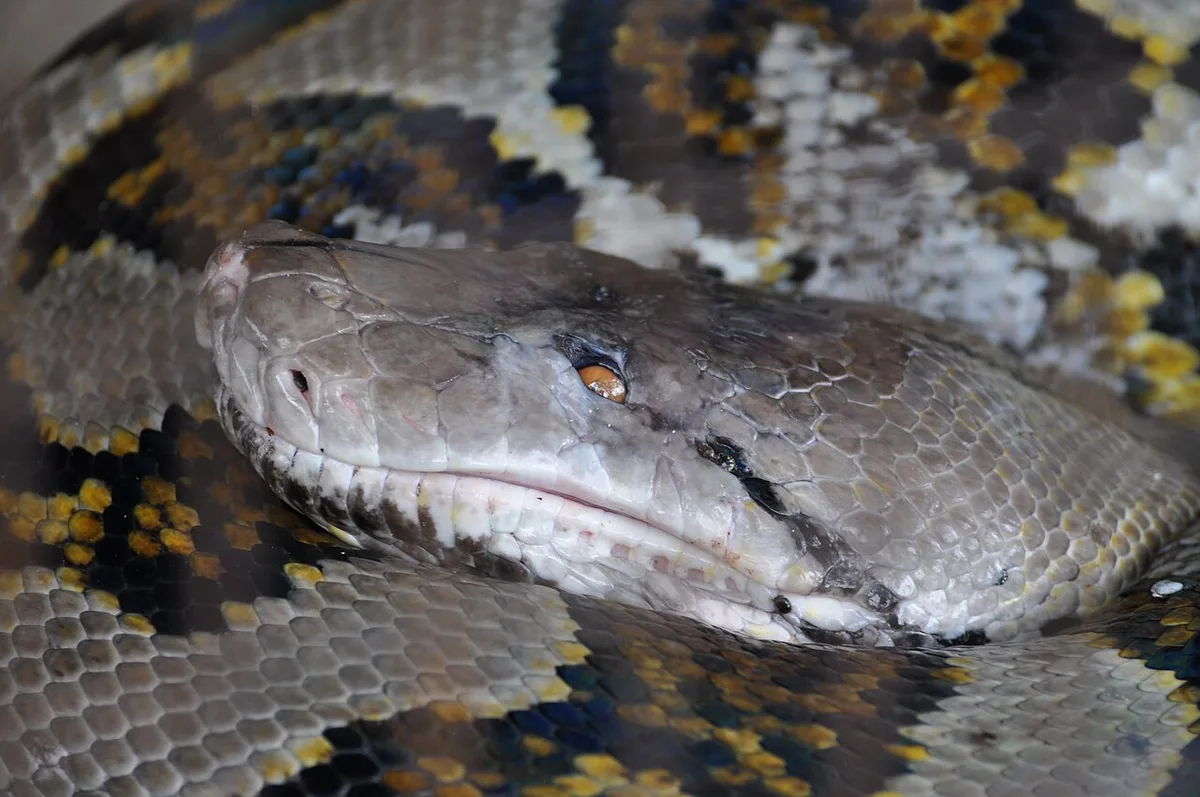
Image source: Wikimedia Commons / shankar s. from Dubai, united arab emirates (CC BY)
The snake’s strategy is built on the element of surprise. A constrictor doesn't have the stamina for a long brawl. Instead, it relies on camouflage to blend into the leaf litter.
Once an unsuspecting ape steps within striking distance, the snake lunges with lightning speed, anchoring itself with backward-curving teeth before wrapping its muscular coils around the primate’s chest.
According to research shared by the San Diego Zoo Wildlife Alliance, large pythons are opportunistic feeders that can consume prey much larger than their own head thanks to highly flexible jaw ligaments. For a juvenile chimp or a lone bonobo, a strike from a 20-foot rock python is often a death sentence. The constriction isn't just about breaking bones; it’s about stopping the heart and preventing the lungs from expanding.
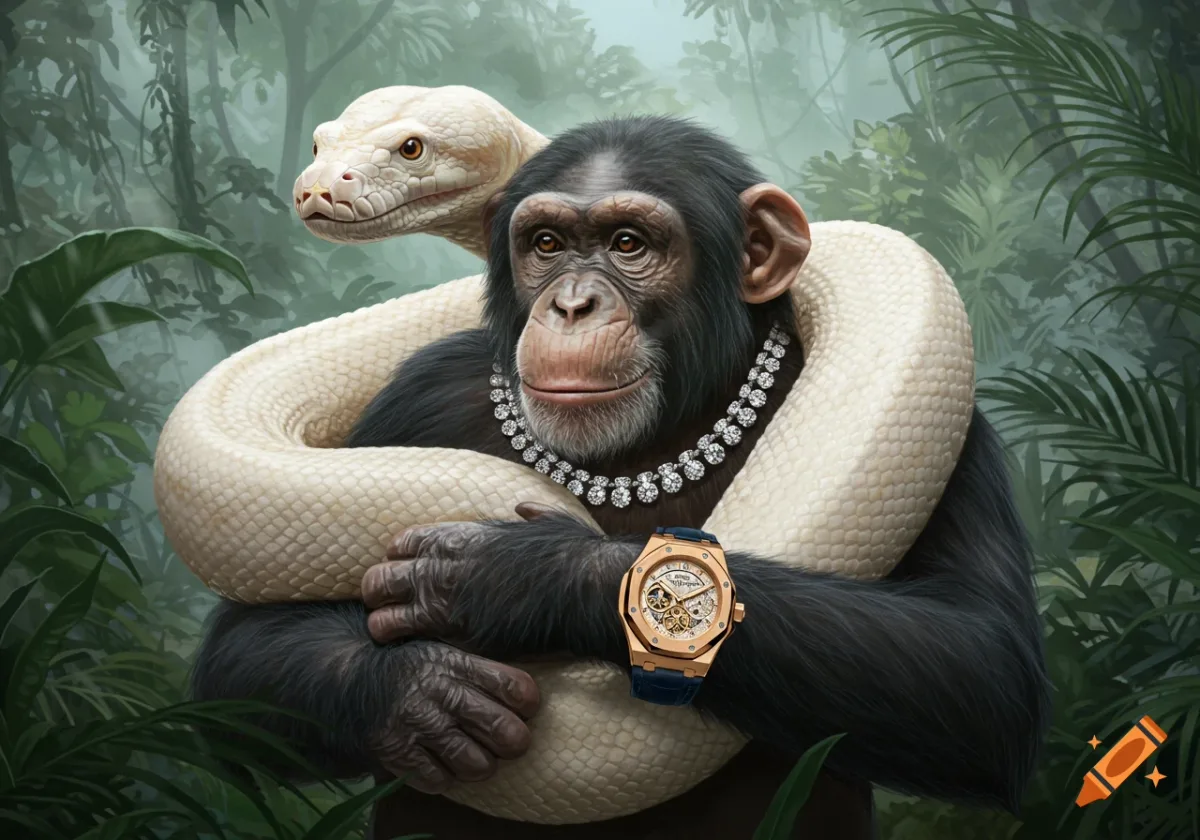
Image source: Web (Bing) / craiyon.com (Web image (fair-use with source credit))
How Apes Use Intelligence to Win
If the snake has the power of the squeeze, the ape has the power of the mind. I’ve watched footage of wild chimps dealing with snakes, and it is nothing short of tactical brilliance. They don't just run away; they often engage in "mobbing."
When a chimp spots a predator, it doesn't just think of its own safety. It alerts the entire group. A solitary snake, even a large one, cannot defend itself against four or five angry, 120-pound apes throwing rocks, swinging heavy branches, and using their massive canine teeth to tear at the snake's midsection.
Apes are incredibly strong, a chimpanzee has significantly more fast-twitch muscle fiber than a human, making them pound-for-pound much stronger than us.
We see similar defensive behaviors in other species; for instance, the way some birds protect their territory against rivals shows that social animals often use numbers to negate a predator's physical advantages.
Comparison of Combat Stats: Ape vs. Snake
| Feature | Great Ape (Chimpanzee/Gorilla) | Large Snake (Python/Cobra) |
|---|---|---|
| Primary Weapon | Canines, Hands, Tools, Logic | Constriction, Venom, Camouflage |
| Defense Strategy | Social mobbing, alarm calls | Hiding, striking from shadows |
| Intelligence | High; uses sticks and stones | Low; driven by instinct |
| Speed | Fast burst speed on ground | Instantaneous strike speed |
| Weakness | Vulnerable to ambush | Low stamina; fragile spine |
The Role of Tool Use in Primate Defense
One of the coolest things about apes is their ability to use the environment to their advantage. While a snake is limited to its body, an ape can "extend" its reach. Chimpanzees have been observed using long sticks to poke at snakes from a safe distance, testing to see if the reptile is alive or simply trying to drive it out of their nesting area.
This behavior isn't just about killing; it's about risk management. Even if an ape is much stronger, a bite from a venomous snake or a nasty infection from a python's mouth is a major risk. By using tools, the ape minimizes the chance of taking damage.
This level of complex social interaction is what sets primates apart from almost every other creature in the forest.
Why Size Matters: Gorillas vs. Pythons
While a chimpanzee might need a group to feel safe, a silverback gorilla is a different story. An adult male gorilla can weigh over 400 pounds. To a gorilla, a snake is more of a nuisance than a mortal threat.
There are very few snakes in the world large enough to successfully constrict an adult gorilla. The sheer girth of a silverback’s neck and chest makes it almost impossible for even a massive African Rock Python to get a lethal wrap.
In these rare encounters, the gorilla usually wins by simply grabbing the snake and slamming it against a tree or biting through its spine. It’s a brutal, quick end for the snake. However, baby gorillas are still very much on the menu for large arboreal snakes, which is why mother gorillas are so fiercely protective.
They have to stay vigilant, much like how people wonder where specific animals sleep to avoid being caught off guard in the dark.
My Personal Experience with Primate Fear
I remember visiting a sanctuary where the keepers were moving a fallen log. Hidden underneath was a non-venomous but large snake. The reaction from the nearby chimpanzee enclosure was instantaneous and chilling.
It wasn't just fear; it was a coordinated, rhythmic shouting, a specific "snake bark" that traveled through the group like wildfire.
Even though these chimps had been in captivity for years, that ancestral memory of the "serpent in the grass" was vivid. One of the older males immediately grabbed a heavy plastic toy and held it like a club, watching the snake's every move. It reminded me that for an ape, the best way to win a fight with a snake is to ensure the fight never happens on the snake's terms.
Much like how people try to identify specific garden visitors to know if they are a threat or a friend, apes are constantly scanning their environment to categorize every movement in the brush.
5 Actionable Ways Apes Protect Their Young from Snakes
- High-Altitude Nesting: Apes build new sleeping platforms every night high in the canopy to stay out of reach of ground-dwelling constrictors.
- Sentinel Behavior: While the group eats, at least one adult usually keeps a lookout for movement in the peripheral foliage.
- Vocal Alarm Systems: Specific calls identify the type of threat, allowing the group to react appropriately (climbing higher vs. mobbing).
- Pathfinding: Dominant males often lead the way through thick brush, taking the initial risk of encountering a hidden predator.
- Sanitation: Keeping nesting areas relatively clear of debris that could hide a small or medium-sized viper.
Can a Snake Ever Win?
It would be unfair to say the snake never wins. In the natural world, the predator only needs to be right once. If a python manages to catch a lone ape while it is sleeping or distracted, the fight is over before it begins.
The snake’s incredible grip is designed to tighten every time the prey exhales. For an ape, the struggle only makes the coils tighter.
However, these instances are rarely documented because apes are so rarely alone. Their survival strategy is built on community. A snake might be the ultimate individual hunter, but it struggles against a "team" of primates.
This is why you’ll often find that in areas with high ape populations, large snakes tend to focus on smaller monkeys or ungulates that lack the group-defense mechanisms of the great apes.
Understanding these dynamics helps us appreciate the complexity of the wild. Whether it's the rarity of seeing a specific creature or the daily battle for survival, every interaction in the jungle is a lesson in biology.
Frequently Asked Questions
Which snake is the biggest threat to a chimpanzee?
The African Rock Python is the primary threat. It is large enough to kill a juvenile or even a small adult chimp and shares much of the same habitat in Central and Western Africa.
Can an orangutan kill a King Cobra?
Orangutans are incredibly cautious. While a King Cobra’s venom is lethal, an orangutan’s reach and ability to use branches as weapons mean it could potentially kill the snake without ever getting close enough to be bitten. However, most orangutans would simply avoid the area.
Do apes eat snakes?
Yes! While they don't hunt them as a primary food source, chimpanzees have been known to kill and occasionally consume small snakes. It’s a mix of eliminating a threat and getting a quick protein snack.
Why are apes so afraid of snakes?
It’s an evolutionary trait called "ophidiophobia." Those who were afraid of snakes lived longer and passed on their genes. This is why even apes that have never seen a snake in their lives often react with fear to snake-like objects.
How do researchers study these fights?
Most data comes from camera traps and long-term field observations by organizations like the Max Planck Institute for Evolutionary Anthropology. These researchers spend decades in the forest to catch these rare moments of interaction.
It’s truly fascinating to see how these two very different branches of life interact. The "ape vs snake" debate isn't just about who is stronger; it's about the clash between raw predatory instinct and the dawn of social intelligence. Every time I see a primate outsmart a predator, I'm reminded of the incredible journey of evolution.
Next time you're out in nature, even if you're just looking at birds in your backyard, take a second to think about the complex survival strategies happening all around you. It makes the world a much more exciting place to explore!

I’m the wildlife researcher and storyteller behind Animal Facts Zone. From backyard insects like butterflies and fireflies to the rarest creatures on Earth, I believe the animal kingdom is full of wonders waiting to be discovered. My mission is to share well-researched, engaging, and family-friendly animal facts that spark curiosity and inspire a deeper appreciation for nature.