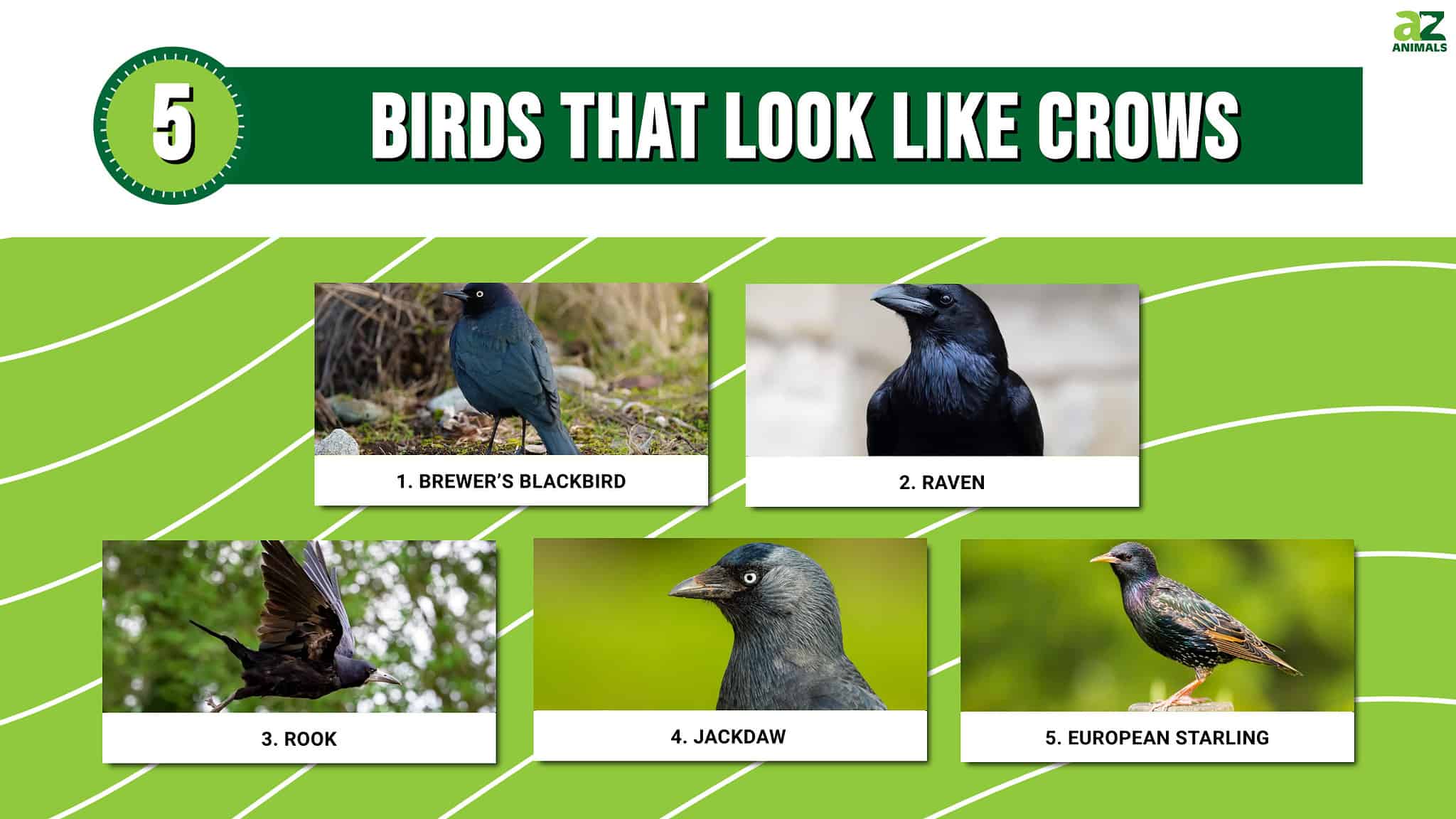
The common raven is one of the birds most often mistaken for a crow in the United States. Common grackles, European starlings, and some other blackbirds can also look like crows from a distance. Size, bill shape, tail shape, flight, calls, and location help you tell them apart.
Across the United States, a large black bird on a telephone pole, fence, parking lot, or lawn often gets called a crow. Yet several birds can create that same first impression. A raven may look like an oversized crow, while a grackle can appear almost crow-like when sunlight hides its blue and bronze shine.
The best way to identify a dark bird is to look beyond its color. Compare its size with nearby birds, watch how it moves, study its tail, and listen to its call. These clues work together like pieces of a puzzle, helping you narrow down the species without catching or disturbing the bird.
This guide focuses on birds that people may confuse with crows in the United States. It explains the most useful differences, where these birds are likely to appear, and what to do when you cannot get a clear view. Some species overlap in appearance, so a careful identification may remain uncertain until you see more clues.
Bing
Which Bird Is Most Often Mistaken for a Crow?
The common raven is one of the closest matches to the American crow. Both belong to the crow family, Corvidae, and both have dark feathers, strong bills, and clever, adaptable behavior. When either bird flies overhead against a bright sky, the lack of visible detail can make identification difficult.
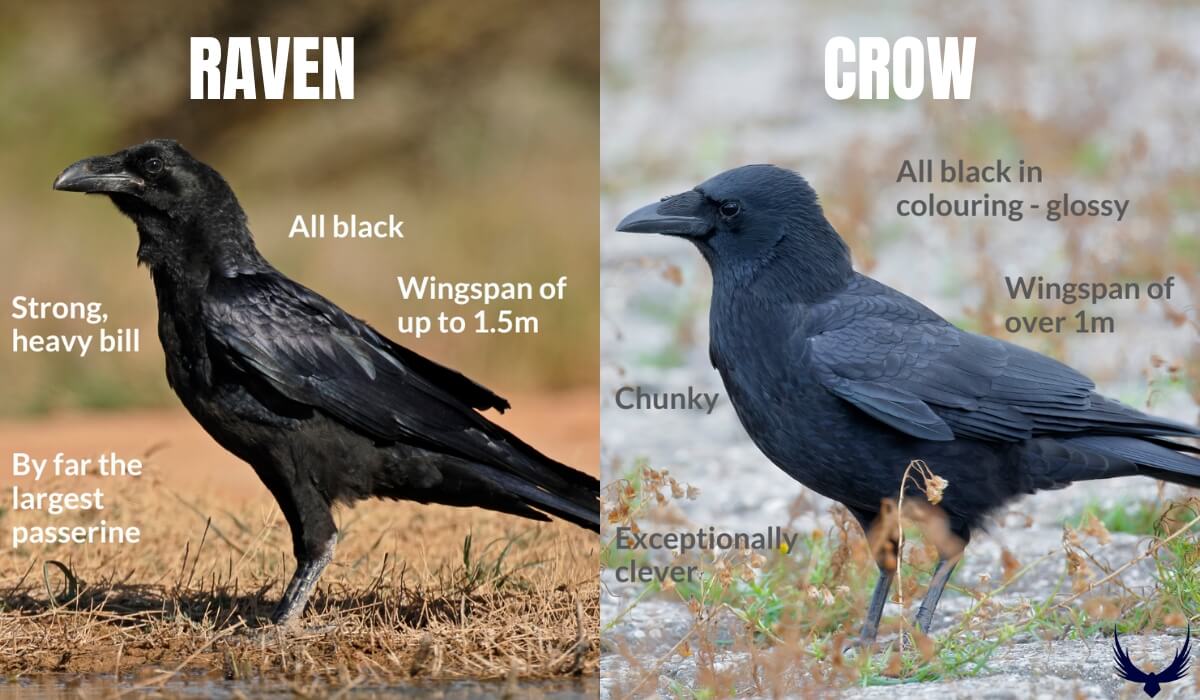
The common raven is usually the easier bird to recognize when you can compare the two side by side. It is larger, has a heavier bill, and often has shaggy throat feathers. Its tail also forms a longer wedge or diamond shape when spread in flight, while an American crow usually has a shorter, rounded or squared tail.
Other birds can fool an observer for different reasons. A common grackle has dark, glossy feathers and a long tail. A European starling may look like a small black crow when seen across a parking lot. The bird’s size and proportions often reveal more than its color.
Bing
Common raven
The closest large black look-alike in much of the western and northern United States. Look for a massive bill, shaggy throat, long wings, and a wedge-shaped tail.
Common grackle
A lanky blackbird with a long tail, long legs, and an often iridescent head and body. It is much smaller than an American crow.
European starling
A compact bird that can appear dark from far away. Its shorter tail and smaller body help separate it from a crow.
Brown-headed cowbird
A stocky blackbird, especially in adult males, that may look like a miniature crow. Adult males have a dark brown head that is easier to see at close range.
1. Common Raven: The Crow’s Larger Look-Alike
The common raven is often the first bird to check when you see a very large, all-black bird in the United States. It shares many features with the American crow, but its proportions are more powerful. An adult common raven is typically about 22 to 27 inches long, while an American crow is about 16 to 21 inches long, according to Cornell Lab of Ornithology identification guides.
Size alone can mislead you. A crow standing close to you may look larger than a raven far away, and puffed feathers can change a bird’s apparent shape. Instead, look at several traits together, including the bill, throat, tail, and flight.
Common ravens occur widely across western and northern North America. They live in habitats ranging from forests and mountains to deserts, coasts, grasslands, and some towns. American crows are widespread in towns, farms, parks, fields, and wooded areas across much of the United States, so the location can help but will not always settle the question.
Bing
Bill
A raven’s bill is usually longer and heavier than a crow’s bill. The head may look more massive as a result.
Throat
Ravens often show shaggy feathers below the bill. These feathers can stand out when the bird calls or moves its head.
Tail
A raven’s tail often looks wedge-shaped in flight. A crow’s tail is generally shorter and more rounded or squared off.
Sound
American crows are known for their familiar cawing calls. Common ravens often make deep, rough croaks or gurgling sounds, although both species have varied calls.
How to Tell a Raven From a Crow in Flight
Watch the tail first. When a raven spreads its tail during a turn or glide, the longer central feathers can create a clear wedge shape. An American crow usually has a shorter tail that looks rounded or squared at the end.
Next, look at the wings. Ravens have long, fairly narrow wings and often alternate strong wingbeats with glides. Crows tend to show broader, more rounded wings and a rowing flight style. These are useful clues, but wind, distance, and the angle of view can make them harder to judge.
Best clue
A combination of a heavy bill, shaggy throat, and long wedge-shaped tail strongly favors a raven.
Common mistake
Do not identify a raven by size alone. Use its body shape and flight features as well.
2. Common Grackle: A Blackbird That Can Fool You
The common grackle can look like a crow at first glance, especially when it stands on a lawn or gathers with other dark birds. Yet it is slimmer and much smaller than an American crow. Its long legs, narrow body, and long tail give it a different shape once you look closely.
Adult male common grackles often have a glossy blue or purple head and a bronzy body. Their bright yellow eyes can also stand out in good light. These colors may disappear when the bird is far away or standing in shade, leaving a dark silhouette that can be mistaken for a crow.
Grackles are common in many parts of the eastern United States and occur in a variety of open habitats. You may find them in parks, fields, marsh edges, suburban lawns, and farmyards. They often gather in groups and walk across the ground while searching for food.
Bing
Body shape
Grackles look lanky, with long legs and a long tail. Crows have a thicker neck and a more solid body.
Eye color
An adult grackle often has a bright yellow eye. An American crow has a dark eye.
Feather shine
Look for blue, purple, or bronze tones on a grackle in sunlight. Crow feathers may also shine, but they do not show the same characteristic grackle pattern.
Movement
Grackles often strut and peck along the ground. Crows also forage on the ground, but their larger, heavier shape is usually clear when the birds are nearby.
Is a Grackle a Crow?
No. A grackle is a member of the blackbird family, Icteridae, while a crow belongs to the family Corvidae. The birds may share dark feathers and flexible diets, but they are not the same kind of bird.
The distinction matters because the word blackbird describes several different species in everyday birding. A common grackle is a specific species, while the American crow is a different species in a separate family. Their calls, body shapes, and behavior can help you tell them apart.
Quick check
If the bird has a very long tail, slender body, and bright yellow eye, consider a grackle before calling it a crow.
3. European Starling: A Smaller Dark Bird
The European starling is another bird that can be mistaken for a crow when it is seen from a distance. It has a compact body, dark plumage, and a short tail. Those traits can disappear in a quick glance, especially when a flock moves across a parking lot or gathers near a building.
At close range, an adult starling often shows glossy feathers with pale speckles, especially during the cooler months. Its bill changes color with the season, becoming yellow during the breeding season in many adults. The starling is much smaller than a crow and often moves in tight, active flocks.
European starlings are common across much of the United States. They use lawns, farms, city streets, open fields, and other places where they can find insects, seeds, or discarded food. A group of starlings may create a dark patch on the ground, but their smaller size becomes clear when they are next to a crow.
Bing
Size
A starling is far smaller than an American crow. Compare it with a robin or another familiar bird if one is nearby.
Tail
Starlings have short tails rather than the longer tail of a crow.
Feathers
Look for pale speckles and a glossy sheen when the bird is close enough to see detail.
Flock behavior
Starlings often form busy flocks. Crows may gather too, but each crow is noticeably larger and heavier.
4. Brown-Headed Cowbird: A Crow-Like Blackbird
A male brown-headed cowbird can look like a small black crow because most of its body is dark. The key feature is its rich brown head, which contrasts with its black body when the light is good. It also has a shorter tail and a more compact body than a crow.
Female brown-headed cowbirds look different. They are brownish overall, with a lighter appearance and less contrast between the head and body. Young birds may also lack the crisp colors seen in adult males, so a single field mark may not be enough for identification.
Brown-headed cowbirds occur across much of the United States and often feed in open country, pastures, lawns, and other grassy areas. They may join mixed flocks of blackbirds, grackles, and starlings. When many species gather together, comparing their sizes is often easier than trying to judge color.
Bing
Male appearance
Look for a brown head and dark body. The contrast is more useful than the overall dark color.
Smaller build
Cowbirds are much smaller than crows, with a compact body and shorter tail.
Feeding area
Open lawns and pastures are good places to watch for cowbirds, though habitat alone cannot confirm the species.
Could a Female Cowbird Look Like a Crow?
A female cowbird can look like a plain brown or dark bird at a distance, but it is still much smaller than an American crow. Its short tail and compact shape are more helpful than plumage color when the light is poor.
If you cannot see the head or body pattern, wait for a clearer view. A bird’s feeding behavior and the company it keeps can support an identification, but neither proves its species on its own.
5. Fish Crow: A Smaller Relative That Resembles an American Crow
The fish crow is a close relative of the American crow and can be very difficult to distinguish by sight alone. Both are black, have similar body shapes, and often live near people. In areas where their ranges overlap, even experienced bird watchers may need to listen carefully.
Fish crows are generally smaller than American crows, but size is not always obvious unless you see both birds together. Their calls are often more nasal, with sounds that may resemble a short, higher-pitched version of a crow’s call. Listen for repeated patterns rather than relying on a single note.
Fish crows occur mainly in the eastern and southeastern United States, especially near coasts, rivers, wetlands, and other waterways. American crows also use these habitats, so the location is a clue rather than a final answer.
Bing
Sound
A nasal call can suggest a fish crow, especially when you hear it several times.
Size
Fish crows tend to be smaller, but individual variation and viewing distance can make this hard to judge.
Range
Waterfront areas in the eastern and southeastern United States are useful places to consider fish crow as an option.
Why Calls Matter More Than Color
American crows and fish crows look alike because they are closely related. Their dark plumage provides little help when the birds are far away or backlit. Their voices can offer a stronger clue, although both species produce more than one call.
If possible, record a short clip from a safe distance and compare it with reliable recordings from a bird identification guide. Do not assume that one unusual call settles the question; repeat observations make the result more dependable.
6. Other Dark Birds That May Be Confused With Crows
Several other birds can look crow-like under the right conditions. Their likelihood depends on the region, habitat, season, and how closely you can see the bird. A distant black shape is not enough to identify a species with confidence.
Red-winged blackbirds, for example, can appear almost entirely black when their red and yellow shoulder patches are hidden. Boat-tailed grackles and great-tailed grackles may look crow-like because they have dark bodies and long tails. Their size, tail shape, and range can help narrow the choices.
In some places, a black vulture may also be mistaken for a large crow when it is perched or seen from below. A vulture has a different flight shape, often with broad wings and a short tail. It may soar for long periods, while crows generally use more active wingbeats.
Bing
Red-winged blackbird
A smaller bird whose bright shoulder patches may be hidden when its wings are folded. It often occurs around marshes, wet fields, and roadside vegetation.
Great-tailed grackle
A long-tailed blackbird common in parts of the southern and southwestern United States. Its very long tail and slender build help separate it from a crow.
Boat-tailed grackle
A large blackbird associated with coastal marshes and shore areas in the southeastern United States. It is smaller and more slender than a crow.
Black vulture
A dark scavenging bird with broad wings and a short tail. Its soaring flight can help distinguish it from a crow.
How to Identify a Crow Look-Alike in the Field
Start with the bird’s overall shape, then check its tail, bill, movement, and sound. This order helps because broad features are often visible before fine details. It also reduces the risk of choosing a species based on one misleading clue.
Try to observe the bird without approaching it. Use binoculars if you have them, and take a photo only when doing so is safe and does not disturb the bird. If the bird flies away, note what you saw rather than chasing it for a better view.
Bing
Step 1: Estimate size
Compare the bird with a familiar object or nearby bird. A raven is generally larger than an American crow, while grackles, starlings, and cowbirds are smaller.
Step 2: Study the bill and head
A raven has a heavier bill and often a shaggy throat. Grackles have a long bill and a flatter head profile, while starlings and cowbirds look more compact.
Step 3: Check the tail
Look for a long wedge-shaped tail in a raven, a shorter squared or rounded tail in a crow, and a long narrow tail in a grackle.
Step 4: Listen
A familiar caw may support an American crow identification. A deep, rough croak may suggest a raven, while a nasal call may suggest a fish crow.
Step 5: Consider the location
Use habitat and geographic range to narrow the choices, but remember that many species share parks, lawns, fields, and waterfronts.
Step 6: Record uncertainty
If important details are missing, label the observation as an unidentified black bird or a possible raven rather than stating a guess as fact.
A Simple Comparison Table
The table below summarizes the most useful field clues. These are typical patterns, not rules that work in every view. Young birds, poor light, distance, and unusual posture can hide important features.
Common raven
Large body, heavy bill, shaggy throat, wedge-shaped tail, and deep croaking calls.
American crow
Large all-black bird, thick neck, moderate bill, rounded or squared tail, and familiar cawing calls.
Common grackle
Smaller, slender body, long tail, long legs, and often glossy purple or bronze feathers.
European starling
Small compact body, short tail, and often speckled glossy feathers at close range.
Brown-headed cowbird
Small stocky bird, short tail, and a brown head in adult males.
Fish crow
Similar to an American crow but often smaller, with a more nasal call.
Black vulture
Broad wings, short tail, and frequent soaring rather than typical crow-like flight.
What If You Cannot See the Bird Clearly?
Do not force an identification from a silhouette. Record the time, location, habitat, approximate size, and any sound you heard. A photograph from the original viewing distance may still help, but blurry images often cannot support a reliable species-level identification.
Compare the observation with a trusted field guide or a bird identification resource such as Cornell Lab of Ornithology’s All About Birds. If the evidence remains weak, keeping the identification broad is the most accurate choice.
Common Identification Mistakes to Avoid
The most common mistake is assuming that every large black bird is a crow. Color is a useful starting point, but many species have dark plumage. A grackle in shade, a raven in flight, and a black vulture on a roof can all create a similar first impression.
Another mistake is relying on only one feature. A long tail may suggest a grackle or raven, but the rest of the body and the bird’s behavior matter too. A crow may briefly fan its tail, and a distant bird’s apparent size can change with perspective.
Finally, do not use location as the only test. Range maps are helpful, but birds move, and many species share the same parks, fields, and urban spaces. Combine location with physical features and sound whenever possible.
Bing
Mistake: Judging only by color
Better approach: Look at body shape, tail, bill, and eye color when visible.
Mistake: Assuming a bigger bird is a raven
Better approach: Check for the heavy bill, shaggy throat, and wedge-shaped tail as well.
Mistake: Treating one call as proof
Better approach: Listen for repeated calls and compare them with reliable recordings.
Mistake: Getting too close
Better approach: Observe from a distance, use binoculars, and leave nesting or resting birds undisturbed.
Frequently Asked Questions
Q
What bird looks exactly like a crow?
No other species looks exactly like an American crow, but the common raven is one of its closest look-alikes. Fish crows can also resemble American crows closely. Size, tail shape, bill shape, calls, and geographic range help distinguish them.
Q
Is a blackbird the same as a crow?
No. The American crow belongs to the family Corvidae. Common grackles, European starlings, and brown-headed cowbirds belong to other bird families. The word blackbird is sometimes used informally for dark-colored birds, but it can also refer to specific species and groups.
Q
How can I tell a crow from a raven without hearing it?
Compare the overall size, bill, throat feathers, wings, and tail. A common raven is generally larger, has a heavier bill and shaggy throat, and often shows a wedge-shaped tail in flight. An American crow usually has a shorter, more rounded or squared tail. Use several features together because no single clue is perfect.
Q
Why do grackles look like crows?
Both birds have dark plumage, and their colors can be hard to see in poor light. Grackles are much smaller and slimmer than crows, with long tails and legs. Adult male common grackles often show glossy blue or purple heads, bronzy bodies, and bright yellow eyes in good light.
Q
Can a crow look brown instead of black?
Yes. Worn or fading feathers can look brownish or scaly, especially during molt. Lighting can also change how dark feathers appear. A brown-looking bird is not automatically a different species, so check its size, bill, tail, and other features before deciding.
Q
Are crows and ravens found throughout the United States?
American crows occur across much of the United States, while common ravens are especially widespread in the West and North and also occur in other regions. Their ranges overlap in some areas. Local habitat and range can help narrow an identification, but they should be considered alongside physical features and calls.
Q
What should I do if I cannot identify a black bird?
Write down the bird’s approximate size, location, habitat, tail shape, bill shape, and any call you heard. Take a photo from a safe distance if possible, then compare the clues with a reliable field guide. If the details are not clear, keep the identification uncertain rather than choosing a species without enough evidence.
✦ Wrapping Up
Conclusion
The common raven is one of the birds most often mistaken for a crow, but it is not the only one. Common grackles, European starlings, brown-headed cowbirds, fish crows, and several other dark birds can create confusion, especially when seen from far away.
The easiest way to tell them apart is to look at the whole bird. Compare its size, bill, tail, body shape, movement, and calls, then use the location as supporting evidence. When the clues do not agree or the view is poor, it is fine to leave the species unidentified until you can observe it again.
💡 Key Takeaway
The next time you see a crow-like bird, check its tail first, compare its size with a familiar bird, and listen to its call. Three matching clues are more useful than a guess based on black feathers alone.
Animal Facts Zone is a family-friendly online resource built for curious minds, students, and wildlife enthusiasts. Founded and edited by Sourov Biswas, the platform breaks down fascinating animal behaviors, species identification guides, and nature trivia into clear, easy-to-read articles.
From backyard butterflies and fireflies to reptiles, birds, and wild matchups, every guide is crafted to answer real questions about the natural world and inspire everyday wildlife appreciation. Whether you are a student researching a species or a nature lover exploring your own backyard, Animal Facts Zone helps you learn something new about the animal kingdom in minutes.
2 thoughts on “What Bird Gets Mistaken for a Crow?: 7 Look-Alikes”




2 thoughts on “What Bird Gets Mistaken for a Crow?: 7 Look-Alikes”