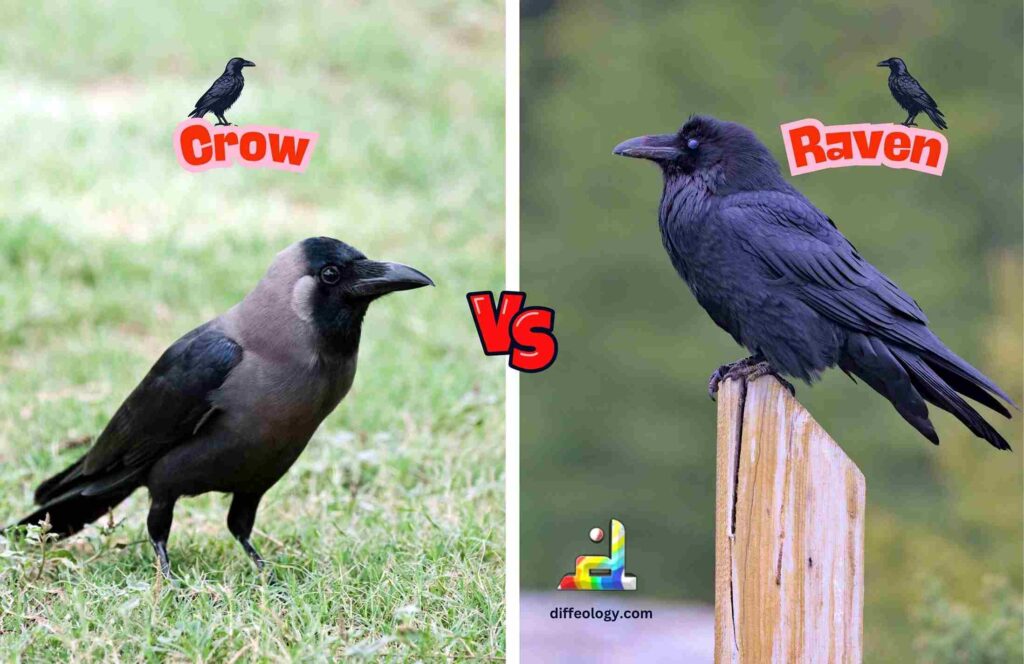
You can tell a crow from a raven by comparing its size, beak, tail, voice, and flight. In the United States, the american Crow is usually smaller, with a slimmer bill and a rounded or fan-shaped tail. The Common Raven is larger, has a heavier bill, a shaggy throat, and a wedge-shaped tail.
Across the United States, black birds are common sights in city parks, backyards, farms, forests, and along mountain roads. You might see one perched on a telephone wire or gliding over a highway and wonder whether it is a crow or a raven. Both birds belong to the crow family, and their dark feathers can make them hard to tell apart at first glance.
The best way to identify one is to look at several features together. Size helps, but distance can make a crow look large or a raven look small. A closer look at the bill, tail, throat feathers, and flight style often gives you a clearer answer.
This guide focuses on the American Crow and Common Raven, two familiar species in North America. Their ranges overlap in parts of the country, so location alone cannot always settle the question. With a few simple checks, you can make a sound identification without getting close to the bird or disturbing it.
Bing
The Quickest Way to Tell a Crow From a Raven
Start with the bird’s overall size, then check its bill and tail. These three clues often provide the fastest answer when you spot a black bird in the United States. The more features you can see, the more reliable your identification becomes.
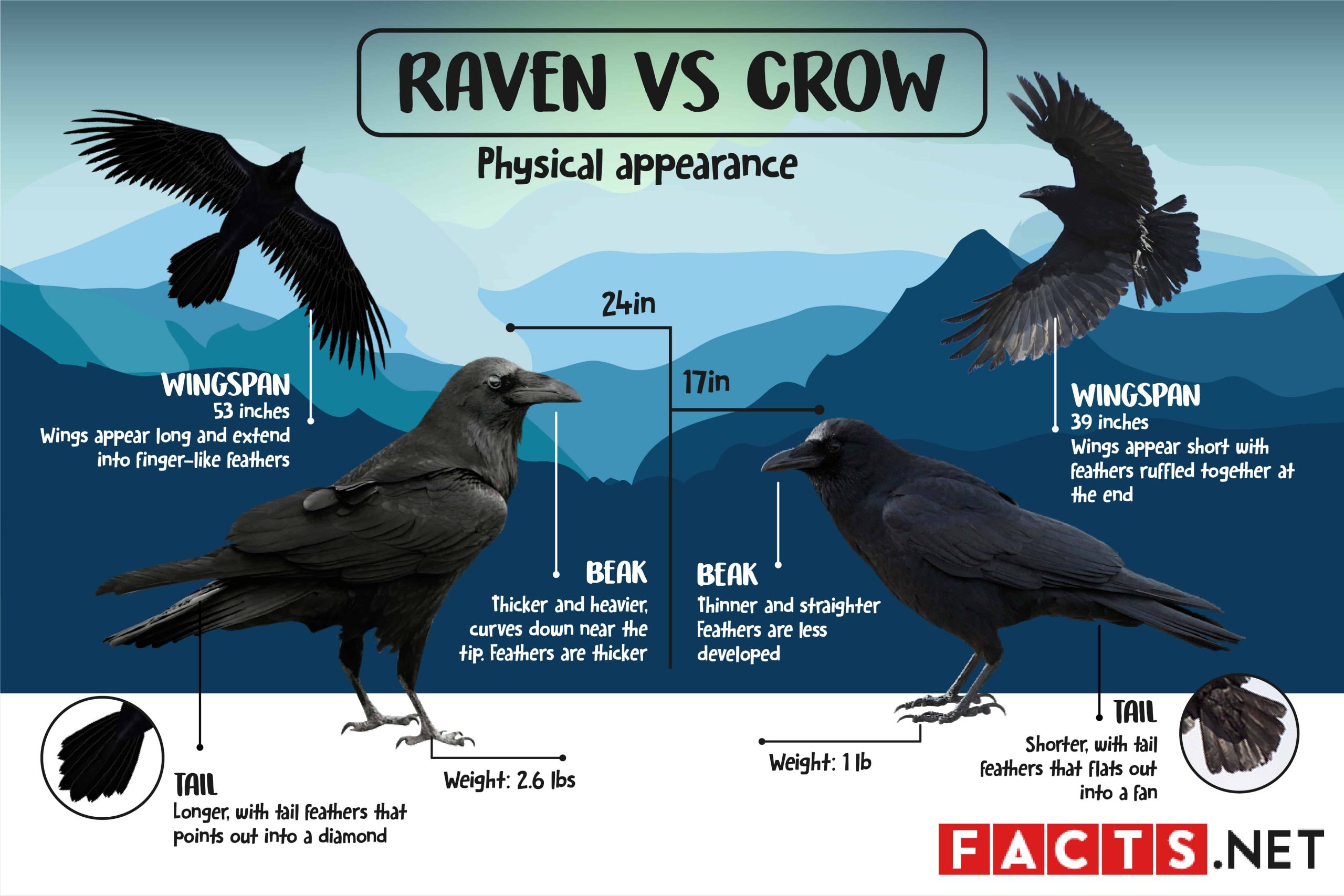
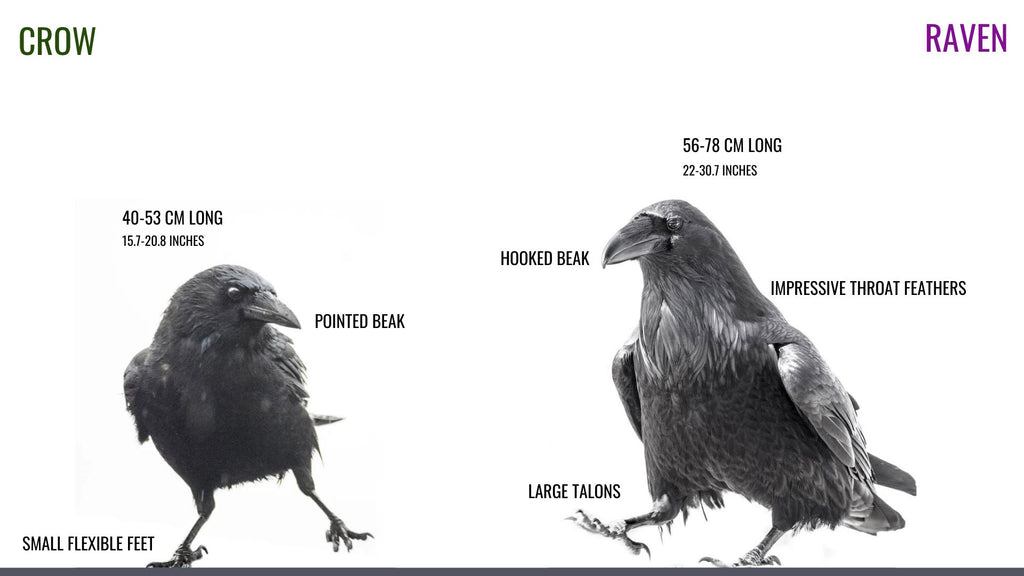
An American Crow is roughly 16 to 21 inches long, while a Common Raven is roughly 21 to 27 inches long. These are approximate body-length ranges, including the tail, and individual birds vary. A raven also tends to have a larger head, a heavier body, and a longer, thicker bill.
Think of the crow as a compact black bird and the raven as its larger, more rugged relative. This comparison is only a starting point, since distance, posture, and viewing angle can change how large a bird appears.
Bing
Overall size
A raven is usually noticeably larger and longer than an American Crow, with a more powerful build.
Bill
A crow has a fairly slender bill. A raven has a thicker, heavier bill that often looks oversized for its head.
Tail
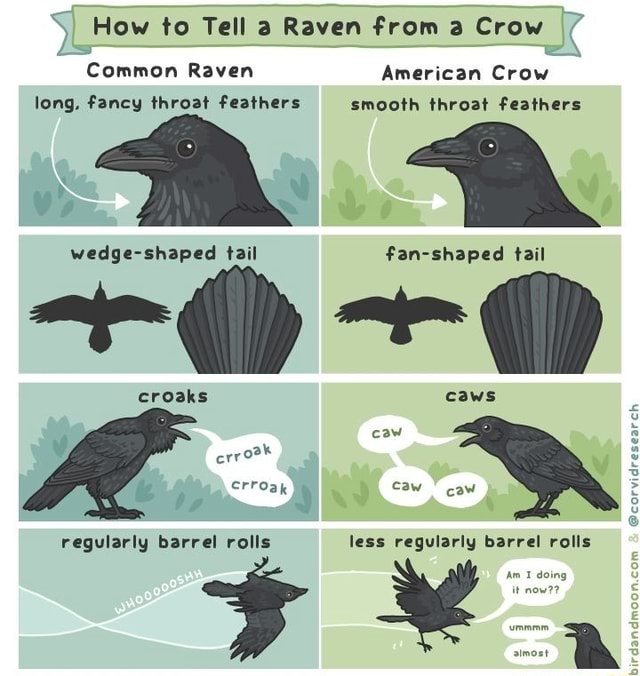
A raven’s tail usually forms a wedge or diamond-like point in flight. A crow’s tail is more often rounded or fan-shaped.
Throat
Ravens often show long, loose throat feathers that look shaggy, especially when they call.
Voice
Crows commonly make familiar caws. Ravens often produce deeper croaks, grunts, and other rough sounds.
Use More Than One Clue
No single feature is perfect in every situation. A distant raven may look small, and a crow seen from below may show a tail shape that is hard to judge. Try to confirm your first impression with at least two or three additional clues.
For example, a large black bird with a thick bill, shaggy throat, and pointed tail is likely a raven. A smaller bird with a slimmer bill, a smooth-looking throat, and a rounded tail is more likely an American Crow.
Best first check
Compare the bird’s size with nearby birds or familiar objects, while allowing for differences in distance.
Best confirmation
Look for a combination of bill shape, tail shape, and voice rather than relying on color alone.
Compare Their Size, Body, and Wings
Size is one of the most useful ways to separate an American Crow from a Common Raven. Ravens generally have a longer body, a broader chest, and a heavier head and bill. Crows look more compact and often appear less bulky when perched beside a raven.
Wingspan also offers a useful clue. An American Crow commonly has a wingspan of about 33 to 39 inches, while a Common Raven can have a wingspan of roughly 45 to 51 inches. These ranges are approximate, and size varies with sex, age, and individual bird.
If you see two birds together, compare their proportions rather than judging one bird in isolation. A raven beside a crow may look strikingly large, but a bird seen alone can be harder to identify because there is no direct size reference.
Bing
American Crow
Usually has a compact body, a medium-sized head, and wings that look less massive than those of a raven.
Common Raven
Usually has a bulky body, a large head, a heavy bill, and long wings suited to soaring.
Why Size Can Be Misleading
A bird’s apparent size depends on how far away it is and whether you are looking up, down, or across an open area. A crow close to your window may seem larger than a raven high above a ridge. Wind and posture can also change the outline of the bird.
Use known objects only with care. A bird perched beside a fence post or sitting on a roof may be easier to judge than one flying alone, but perspective still affects the comparison. If size remains uncertain, move on to the tail, bill, and voice.
Look for proportions
A heavy head and bill, broad chest, and long wings support a raven identification.
Avoid judging from distance alone
A large-looking bird is not automatically a raven, especially when there is no clear size reference.
Check the Beak and Feathers Around the Throat
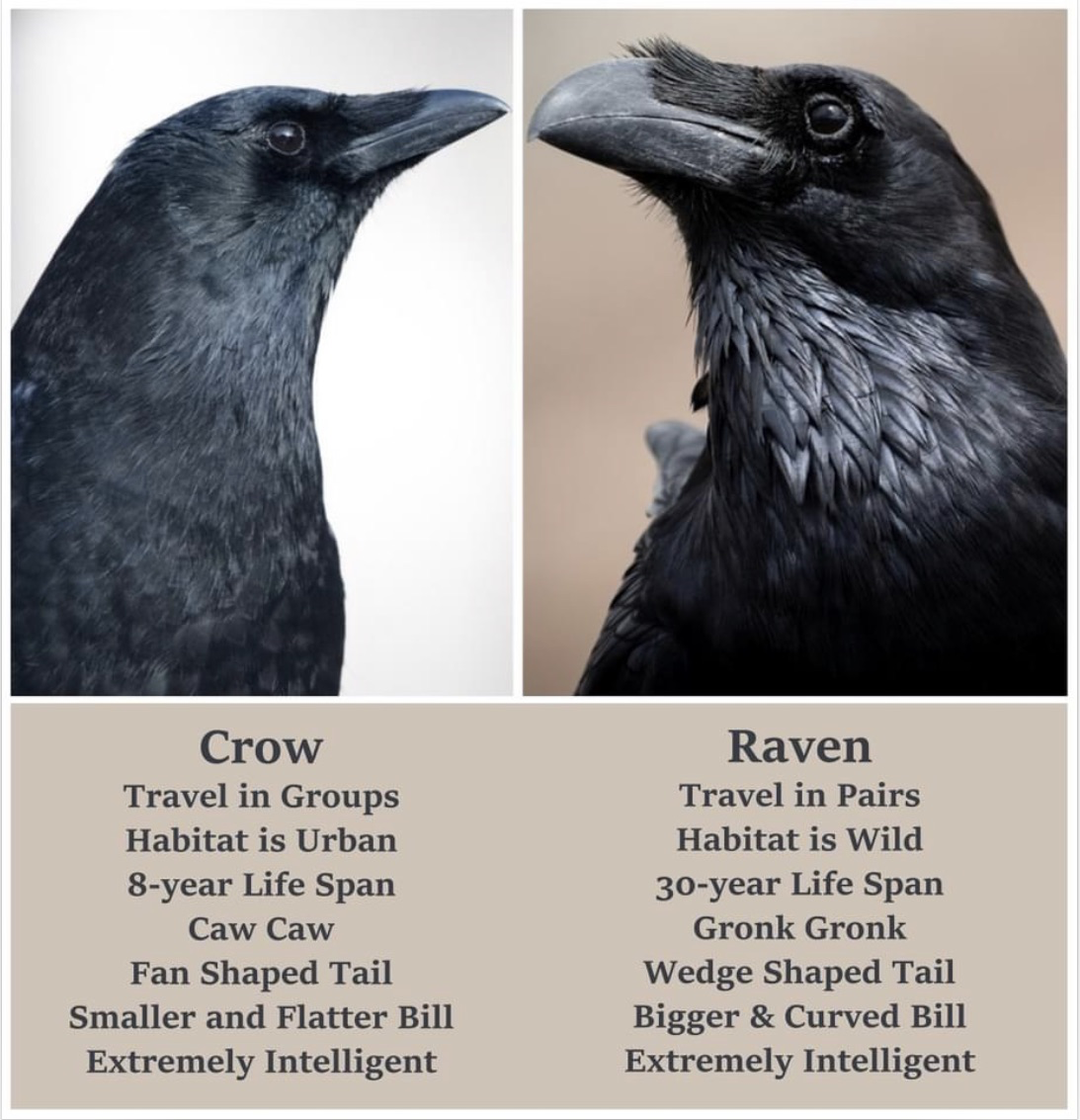
A raven’s bill is usually thicker, deeper, and more powerful-looking than a crow’s. Its upper bill may look strongly curved near the tip, giving the bird a rugged profile. An American Crow has a more slender bill that looks better suited to its smaller head.
Next, look at the throat. Common Ravens have long, pointed throat feathers, often called hackles, that can hang loosely when the bird calls or moves its head. These feathers can make the front of the neck look rough or shaggy.
An American Crow’s throat usually looks smoother and more even. Still, feathers can be fluffed by wind, cold, or posture, so a crow may look unusually shaggy for a moment. The bill and throat should support your decision, not make it for you alone.
Bing
Heavier bill
A thick bill combined with a large head is a strong clue for a Common Raven.
Shaggy throat
Long throat feathers are often visible when a raven calls, preens, or changes posture.
Smoother profile
An American Crow usually has a slimmer bill and a less shaggy-looking throat.
What If You Only See the Bird’s Head?
A side view can still reveal useful clues. Look at the depth of the bill, the size of the head, and whether the throat feathers extend into a loose fringe. A raven’s head often looks larger and more powerful than a crow’s.
If the bird is facing away or the light is poor, wait for a better angle if you can do so without disturbing it. A short observation from a distance is more useful than approaching a wild bird to inspect its feathers.
Best viewing angle
A side view often makes bill depth and throat feathers easier to compare.
What not to do
Do not try to catch or handle a wild crow or raven to check its features.
Look at the Tail When the Bird Flies
The tail is one of the clearest clues when you see a crow or raven in flight. A Common Raven often shows a long, wedge-shaped tail, with the middle feathers extending farther than the outer feathers. From below, this can create a pointed outline.
An American Crow usually has a shorter-looking, more rounded tail. When its tail feathers spread, the outline may look like a fan. The difference can be subtle if the bird is banking, flapping, or seen from an angle.
Wait for the bird to change direction if you can. A side view may hide the tail’s shape, while a view from behind or below may reveal it. Do not assume that every pointed-looking tail belongs to a raven, because the angle of flight can alter the outline.
Bing
Raven tail
Usually long and wedge-shaped, with the center feathers extending beyond the outer feathers.
Crow tail
Usually more rounded or fan-shaped, especially when the tail is spread during flight.
Observe the Whole Flight Pattern
Ravens often use their long wings to soar, glide, and ride rising air currents. In open country, they may circle above cliffs, ridges, or valleys with little flapping. Crows often use more frequent wingbeats during routine travel, although they also glide and soar when conditions allow.
Flight style is a supporting clue rather than a strict rule. Wind, terrain, and the bird’s purpose all affect how it moves. A crow escaping a threat may fly differently from one heading to a feeding area, and a raven may flap often when flying through still air.
Raven movement
Look for broad wings, sustained glides, and effortless soaring in suitable air currents.
Crow movement
Look for a compact silhouette and more frequent wingbeats during ordinary flight.
Listen to the Call: Caw or Croak?
The voice can help you identify a black bird even when you cannot see its body clearly. American Crows often make a familiar, fairly sharp caw. They also produce clicks, rattles, and other calls, so their sound is not limited to one note.
Common Ravens often give a deep, rough croak that sounds lower and more resonant than a crow’s call. They can also grunt, cluck, and make rattling or gurgling sounds. The exact sound varies with the bird, its social setting, and what it is doing.
Listen to several calls rather than judging from one short sound. A distant crow may sound rough, and a raven heard through trees or traffic may lose some of its deep tone. If possible, match the call with the bird’s size and shape.
Bing
American Crow
Often gives a sharp caw that may repeat in a familiar series.
Common Raven
Often makes deeper croaks, harsh grunts, and resonant calls.
Other sounds
Both species use a wider range of sounds than their best-known calls, so sound should be combined with visual clues.
How to Listen Without Guessing
First, note whether the sound is high and sharp or low and rough. Then listen for repeated patterns and watch for a bird that calls while perched or flying. The combination of sound and shape can be much more useful than a recording played on its own.
Do not play loud bird calls to force a response. Playback can stress wildlife, draw birds away from important activities, or cause territorial reactions. Quiet observation is usually enough for casual identification.
Record from a distance
A short audio or video clip can help you compare the call later with a trusted bird identification guide.
Keep the setting in mind
Traffic, wind, echoes, and nearby birds can alter how a call sounds to a listener.
Use Location to Narrow Down the Species
Where you see the bird can help, but location should not be your only test. American Crows occur across much of the contiguous United States and are also found in parts of Canada and other nearby regions. They thrive in many settings, including cities, farmland, forests, and suburban neighborhoods.
Common Ravens occur across much of the United States as well, with a strong presence in western and northern regions, mountain country, deserts, forests, and remote open areas. They also occur in some eastern and northeastern areas. Their distribution overlaps with that of American Crows in many places.
A large black bird over a rocky western canyon may be a raven, while a group of black birds feeding on a suburban lawn may be American Crows. These are useful starting guesses, not proof. Both species can use varied habitats, and local conditions can bring them into the same area.
Bing
Cities and suburbs
American Crows are common in urban and suburban settings, although ravens also use some towns and developed areas.
Mountains and open country
Common Ravens are familiar sights in mountain regions, cliffs, deserts, and broad open landscapes.
Overlapping ranges
In areas where both species occur, use physical features and calls to make the final identification.
Why Habitat Is Not a Guarantee
Birds are adaptable, and their use of an area depends on food, nesting sites, weather, and human activity. A raven may visit a town for food, while a crow may travel through open farmland or along a mountain road.
When you are unsure, note the state or region, habitat, approximate size, and visible features. Those details can help you compare the bird with a reliable field guide or a regional bird checklist.
Record the setting
Note whether the bird was in a city, forest, coastal area, desert, farm, or mountain region.
Check local species
Use a current regional bird guide to confirm which crow and raven species occur in the area.
Compare Their Behavior and Social Habits
American Crows are often seen in family groups, loose flocks, or large gatherings at communal roosts. They may search lawns for insects, visit fields for food, or gather around a source of food. Their social behavior can make a group of crows seem noisy and busy.
Common Ravens are often seen alone, in pairs, or in small groups, though they may gather at rich food sources or communal roosts. They can soar over large areas while searching for food and may investigate carcasses, refuse, or other feeding opportunities.
These are general patterns, not firm identification rules. A single crow can look like a raven from a distance, and a group of ravens can gather around food. Behavior is most helpful when it supports what you already see in the bird’s shape and size.
Bing
Group size
Large groups of noisy black birds often include American Crows, but ravens may also gather under the right conditions.
Feeding behavior
Both birds are opportunistic feeders and may eat insects, seeds, fruit, small animals, carrion, and human food waste.
Problem-solving
Both species are intelligent members of the crow family, so clever behavior does not identify a bird by itself.
Are Ravens More Intelligent Than Crows?
Both crows and ravens show complex behavior, learn from experience, and respond to changes in their surroundings. Members of the crow family can solve problems, remember useful information, and adjust their behavior when conditions change.
It is misleading to use intelligence as a simple ranking test. The two species differ in body size, ecology, and behavior, and performance depends on the task being studied. If your goal is identification, focus on visible and audible traits instead of trying to judge which bird seems smarter.
What intelligence tells you
It shows that these birds can adapt to their environment, but it does not reliably distinguish a crow from a raven.
What to observe instead
Look at the bill, tail, throat feathers, body proportions, voice, and flight style.
A Simple Step-by-Step Identification Method
You do not need to identify every feature at once. Use a short checklist and move from the easiest clues to the harder ones. This approach works well in a backyard, at a park, or while watching birds along a road.
Start with the overall body, then check the bill, tail, and throat. If the bird calls or takes flight, use its sound and movement to confirm your first impression. If the evidence is mixed, record it as an uncertain crow or raven rather than forcing a definite answer.
Step 1: Judge the size
Ask whether the bird looks compact like an American Crow or large and heavy like a Common Raven.
Step 2: Inspect the bill
Look for a relatively slim crow bill or a thick raven bill with a powerful profile.
Step 3: Check the throat
Look for the longer, shaggy throat feathers often seen on ravens.
Step 4: Watch the tail
If the bird flies, look for a raven’s wedge-shaped tail or a crow’s more rounded tail.
Step 5: Listen to the call
A sharp caw often fits a crow, while a deep croak often fits a raven. Confirm with other features.
Step 6: Consider the location
Check whether both species are found in the region, then use the physical clues to make your decision.
What to Do When You Cannot Get a Clear View
If the bird is too far away, take a photo with a phone or camera and enlarge it later. A picture may reveal the bill shape, body proportions, or tail outline that was hard to see in real time. Binoculars can also help, provided you use them from a safe distance.
Do not rely on a dark silhouette alone. If the bird is backlit, its bill and throat feathers may disappear into the outline. Wait for better light or a different angle, and keep the identification tentative until more details are visible.
Use a field guide
Compare the photo with reliable illustrations or photographs of American Crows and Common Ravens.
Keep a short record
Write down the date, location, habitat, approximate size, call, and flight pattern.
Common Mistakes When Identifying Crows and Ravens
The most common mistake is treating black feathers as the main identifying feature. Both American Crows and Common Ravens have dark plumage, so color alone does not separate them. Body shape, bill size, tail shape, and voice are more useful.
Another mistake is assuming that every large black bird is a raven. Some birds appear large because they are close to the observer, and other black birds may resemble crows or ravens from a distance. If the bill and tail do not fit, consider other species rather than forcing the identification.
It is also easy to overvalue one behavior. A bird that scavenges, gathers with others, or solves a problem may be a crow or a raven. Both species have flexible diets and complex social lives.
Mistake: Using color alone
Correction: Compare the body, bill, tail, throat, and call.
Mistake: Assuming all large birds are ravens
Correction: Consider distance, perspective, and other possible black bird species.
Mistake: Trusting habitat as proof
Correction: Remember that the two species overlap in many parts of the United States.
Mistake: Using one call as a final answer
Correction: Listen to several calls and compare them with physical features.
Could It Be a Different Black Bird?
Yes. Depending on where you are in the United States, a black bird that resembles a crow could be a Common Grackle, European Starling, or another species. Grackles often have slimmer bodies and longer tails, while starlings are much smaller than crows and may show glossy plumage or pale speckles at certain times of year.
A raven-sized silhouette may also be misjudged if the bird is seen against the sky. Check the body shape and bill before deciding that the bird must be a crow or raven. A regional field guide can help narrow down alternatives.
Common Grackle
Often has a long, tapered tail and a slimmer profile than a raven.
European Starling
Much smaller than either a crow or raven, with a short tail and a pointed bill.
What to Do if You Want a More Certain Identification
When a sighting remains uncertain, collect evidence rather than guessing. A clear photo of the bird’s side, a second view of its tail, and a recording of its call can provide useful details. Note whether the bird was perched or flying and whether other birds were nearby.
Compare your observations with a trusted bird identification resource, such as a current field guide or a species account from a recognized bird organization. Pay attention to the species’ documented range and the specific features shown in the illustrations.
You can also ask a local birding group to review your photo or recording. Include the location at a broad level, such as the state or county, but avoid sharing private details about your home. If the evidence is too limited, it is reasonable to record the sighting as an unidentified crow-like bird.
Best photo
Capture the bird’s full body and, if possible, a side view of the bill and throat.
Best flight view
Look for the tail outline and wing shape as the bird passes or turns.
Best notes
Record the general location, habitat, approximate size, voice, and behavior.
Observe Wildlife Safely
Keep a respectful distance and let the bird carry on with its normal activities. Do not approach a nest, corner a bird, or attempt to handle it for a better view. Crows and ravens may defend their young, and repeated disturbance can disrupt their behavior.
If a bird appears injured or unable to fly, do not assume that it needs help simply because it is on the ground. Young birds may spend time outside the nest while their parents continue to feed them. If the bird is clearly injured or in immediate danger, contact a licensed wildlife rehabilitator or local wildlife authority for advice.
Keep your distance
Use binoculars or a camera instead of walking toward the bird.
Protect nests
Avoid disturbing nesting sites, especially during the breeding season.
Seek qualified help
Contact a licensed wildlife rehabilitator if an animal appears seriously injured or needs professional care.
Frequently Asked Questions
Q
Is a raven just a big crow?
No. A raven is a separate species, not simply a large American Crow. Both belong to the family Corvidae, but they have different body proportions, calls, and other identifying features. The Common Raven is generally larger and has a heavier bill, a shaggy throat, and a wedge-shaped tail.
Q
Which is more common in American backyards, crows or ravens?
American Crows are common in many cities, suburbs, farms, and parks across the United States. Ravens also visit some developed areas, but they are often associated with mountain regions, forests, deserts, and open country. The likely species depends on your region and the bird’s features.
Q
Can a crow and a raven have the same call?
Their calls can sound similar in some situations, especially when heard from far away or through traffic and wind. American Crows often make sharp caws, while Common Ravens often produce deep croaks and rough grunts. Both species make several types of sounds, so listen for a pattern and check the bird’s appearance.
Q
Do crows and ravens have different tail shapes?
Yes. A Common Raven’s tail usually looks wedge-shaped in flight because the middle feathers extend farther than the outer feathers. An American Crow’s tail is generally more rounded or fan-shaped. The difference is easiest to judge when the bird is flying and the tail is fully visible.
Q
Are ravens always found in the western United States?
No. Common Ravens occur across much of the United States, including many western and northern areas as well as parts of the East and Northeast. Their range overlaps with American Crows in numerous regions. Check a current range map for your location, then confirm the bird using its size, bill, tail, and call.
Q
Can I identify a crow or raven from a photograph?
Often, yes, if the photograph shows enough detail. A clear side view can reveal bill shape and throat feathers, while a flight photo may show the tail outline. A distant silhouette or blurry image may not provide enough evidence, so use more than one photograph or record the identification as uncertain.
✦ Wrapping Up
Conclusion
The easiest way to tell a crow from a raven is to compare its size, bill, throat feathers, tail, and voice. An American Crow is usually smaller and more compact, with a slimmer bill and a rounded tail. A Common Raven is usually larger, with a heavier bill, shaggy throat feathers, a deeper call, and a wedge-shaped tail.
Location and behavior can support your identification, but neither is enough on its own. Both birds occur in a range of habitats, and their ranges overlap across parts of the United States. When the clues do not agree, take a photo, listen to the call, and consult a reliable field guide rather than making a firm guess.
💡 Key Takeaway
Next time you see a black bird, check its size first, then look at its bill and tail. Listen for its call if you can, and use at least three clues together before deciding whether it is an American Crow or a Common Raven.
Animal Facts Zone is a family-friendly online resource built for curious minds, students, and wildlife enthusiasts. Founded and edited by Sourov Biswas, the platform breaks down fascinating animal behaviors, species identification guides, and nature trivia into clear, easy-to-read articles.
From backyard butterflies and fireflies to reptiles, birds, and wild matchups, every guide is crafted to answer real questions about the natural world and inspire everyday wildlife appreciation. Whether you are a student researching a species or a nature lover exploring your own backyard, Animal Facts Zone helps you learn something new about the animal kingdom in minutes.