Seeing a raven in the United States is not especially rare in many regions, but it can be an unusual sight in places where these birds are scarce. Common Ravens live across much of Alaska, the western United States, parts of the Northeast, and many mountain and rural areas. Your chances depend on where you live, the habitat nearby, the season, and whether you can tell a raven from a crow.
Imagine driving through a mountain pass in Wyoming and seeing a large black bird glide over the road. Its broad wings, long tail, and deep croak may point to a Common Raven rather than an American Crow. In much of the western United States, ravens are a familiar part of the landscape, yet someone living in a dense urban neighborhood in another region may rarely notice one.
The Common Raven (Corvus corax) is a large member of the crow family, Corvidae. It lives in a wide range of habitats, including mountains, forests, deserts, coastal areas, farms, and some cities. Its broad range means that a raven sighting is not automatically a rare wildlife event, even though the bird may seem uncommon to people who live outside its main areas.
The best way to judge a sighting is to consider both geography and identification. A large black bird is not always a raven, and a bird that looks like a crow from far away may reveal different features when it flies closer. With a little practice, you can learn where ravens are likely to appear and what signs help confirm an identification.
Source: Bing
Are Ravens Rare in the United States?
Ravens are not rare across the United States as a whole, but their local abundance varies. The Common Raven is widespread in Alaska and much of the western half of the country. It also occurs in parts of the Northeast, northern forests, mountain ranges, and other suitable areas.
In places with rocky cliffs, open land, forests, or abundant food, you may see ravens on a regular basis. They can perch on roadside signs, soar over ridges, forage near campsites, or feed on animal remains. In these settings, spotting one may be an ordinary part of a walk or drive.
The experience can be quite different in areas dominated by American Crows. A person living in a large city in the eastern United States may see crows every day but rarely notice a raven. This does not mean that ravens are rare everywhere. It means that the local landscape and the regional distribution of the two species shape what people see.
The Common Raven has a broad range across North America and much of the Northern Hemisphere. It is not confined to a small breeding area or a single type of habitat. That wide distribution is one reason a sighting should not be treated as extraordinary without considering the location.
Source: Bing
In the western United States
Ravens are familiar in many parts of the West, including mountain country, deserts, forests, rural roads, and some towns.
In Alaska
Common Ravens occur across a broad range of Alaskan habitats, including coastal communities and inland landscapes.
In the eastern United States
Ravens occur in several northern and mountainous areas, but they are less familiar in many places where American Crows are more widespread.
In dense urban neighborhoods
A raven may be present but less likely to be noticed than a crow, especially where nearby habitat and food sources favor crows.
Does a Raven Sighting Mean the Bird Is Rare?
No. A rare sighting for one person does not prove that the species is rare. Someone who has spent years in an area with few ravens may be thrilled to see one, while a resident of a mountain town may see several in a single week.
It helps to separate three ideas: how widespread a species is, how many birds live in a specific area, and how often a person notices one. These are related but different measures. A widespread species can still be uncommon in a particular neighborhood.
Species range
The geographic area where a species occurs.
Local abundance
How many birds occur in a particular place.
Personal encounter rate
How often an observer sees a bird during a given period.
Where Are You Most Likely to See a Raven?
Your best chance of seeing a raven is usually in a region where the species is established and the landscape provides food, nesting sites, and places to perch. In the United States, the western states and Alaska offer many such opportunities. Mountain ranges, open deserts, coastal areas, and broad stretches of rural land can all support ravens.
Ravens are flexible birds. They may nest on cliffs or ledges, use trees in suitable habitats, and forage over large areas. Their ability to use different environments helps explain why they can live far from people in one region and near homes, roads, or towns in another.
A good viewing area does not need to be a national park. A rural highway, a rocky overlook, a forest edge, or a quiet stretch of coastline may be enough. Look for large birds soaring high above open ground or resting on tall structures where they can scan the surrounding area.
Because raven distribution is uneven, local bird records are more useful than a broad national statement. A current regional range map or recent sightings from a trusted bird-recording source can help you decide whether a nearby park or trail is a sensible place to look.
Source: Bing
Mountain ranges
Cliffs, open slopes, and updrafts provide nesting sites and good conditions for soaring.
Desert landscapes
Ravens can forage across open terrain and use scattered cliffs, trees, and human structures as resting places.
Forests and woodland edges
Suitable trees and nearby open feeding areas can make these places useful habitat.
Coastal areas
Food along beaches, rocky shores, and coastal settlements can attract ravens.
Rural roads and towns
Roadkill, discarded food, and other food sources may draw ravens into areas used by people.
Are Ravens Common in Cities?
Some cities and towns have resident ravens, while others are known mainly for American Crows. Urban sightings depend on local habitat, food, nesting sites, and the bird populations already established in the area.
Ravens may visit parks, industrial areas, large green spaces, or the edges of towns. They can also use buildings and other structures for resting or nesting where conditions allow. Still, seeing a raven in a city where they are uncommon may take more time than finding one in suitable rural or mountain habitat.
Check city edges
Large parks, open land, rocky areas, and less developed outskirts may offer better viewing opportunities than crowded streets.
Look above the skyline
A raven may be easier to notice while soaring over buildings than when perched among trees.
Confirm the identification
Crows are widespread in many cities, so size alone is not enough to establish that you saw a raven.
How Can You Tell a Raven From a Crow?
The most common reason people misjudge raven sightings is confusion with American Crows. Both birds are black, intelligent, adaptable, and members of the same family. From a distance, especially in poor light, their shapes can look very similar.
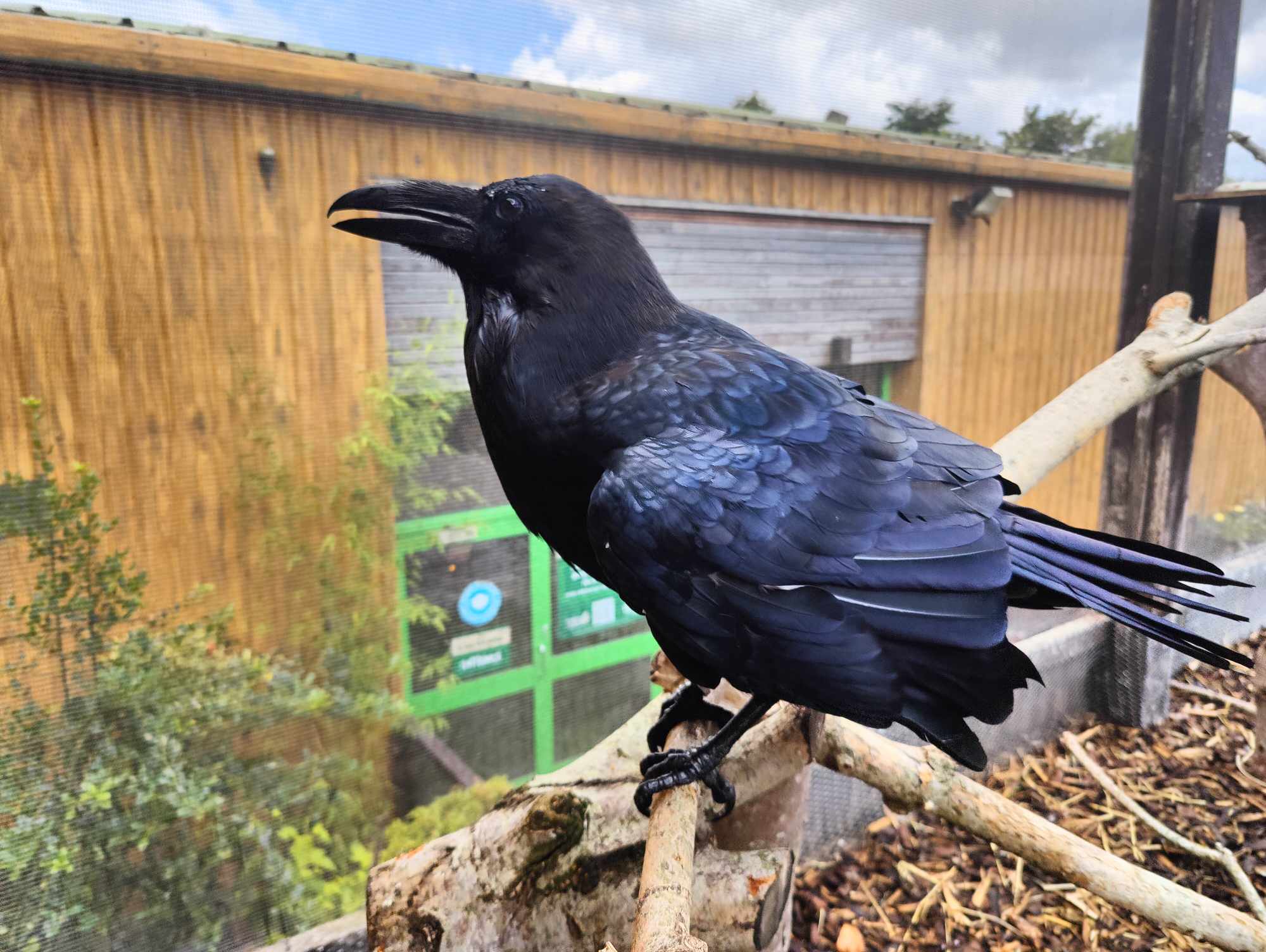
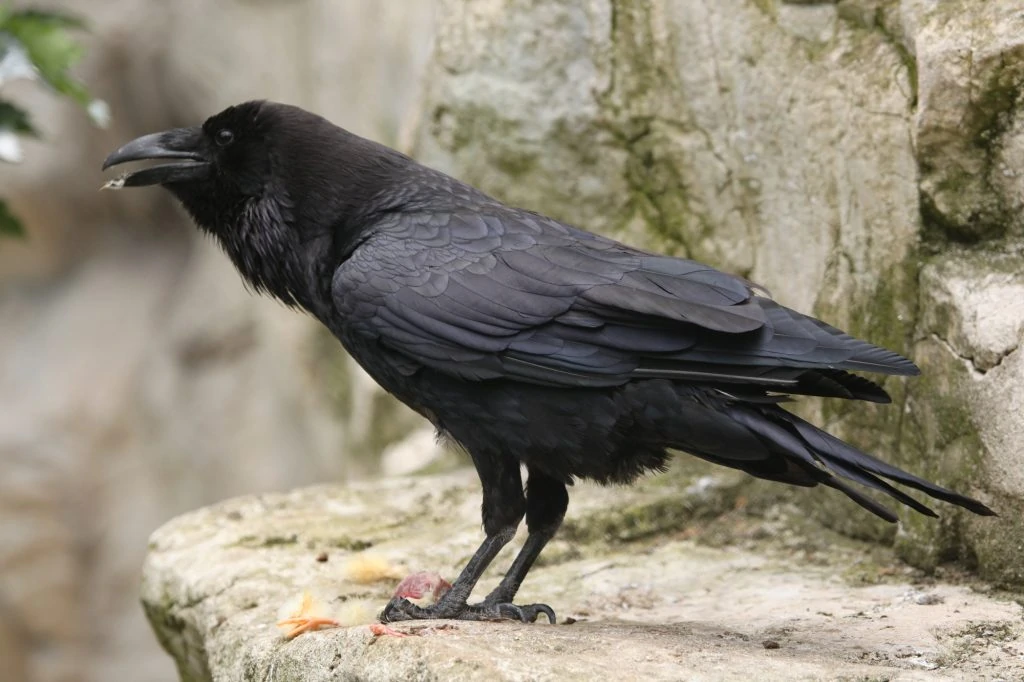
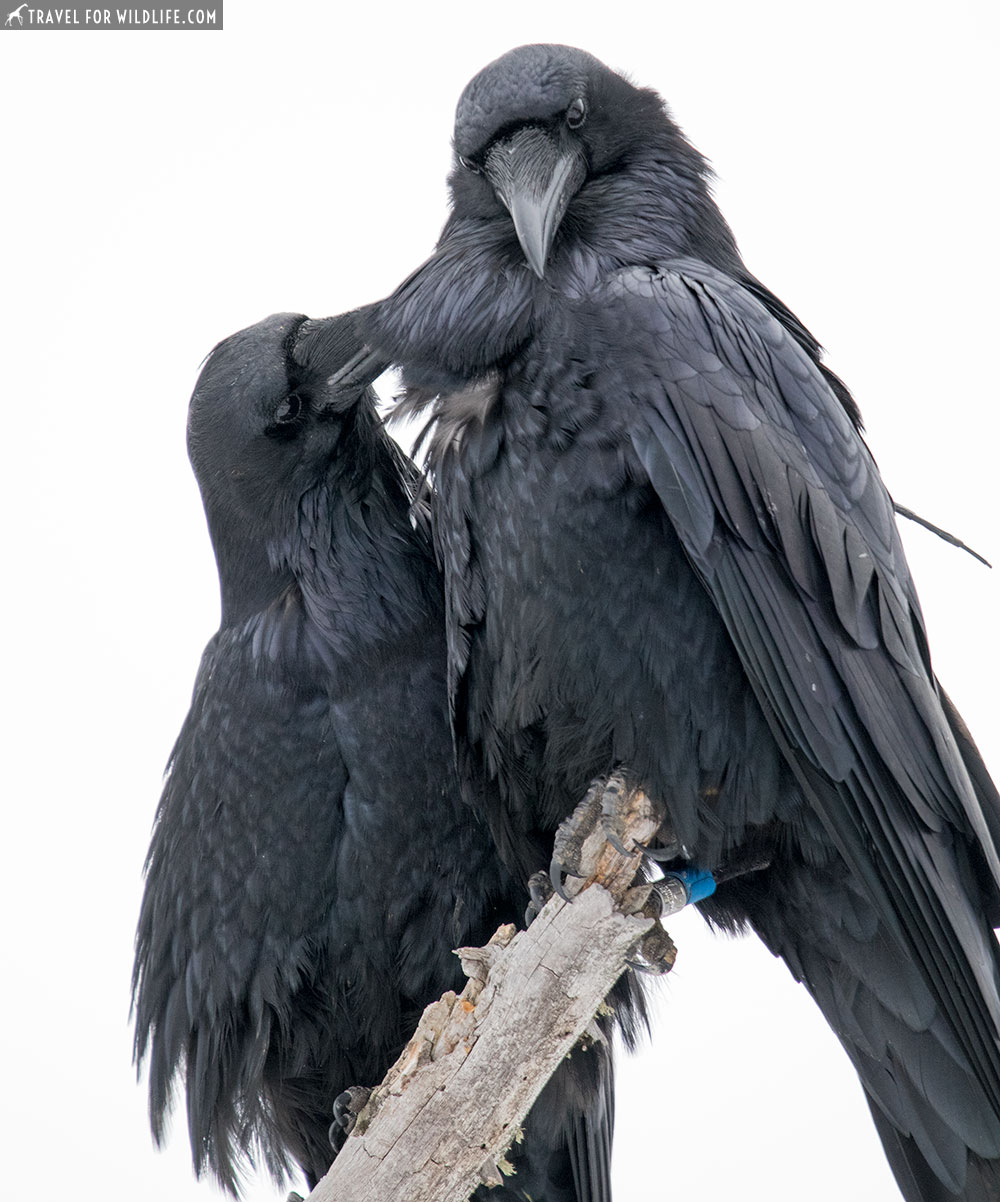
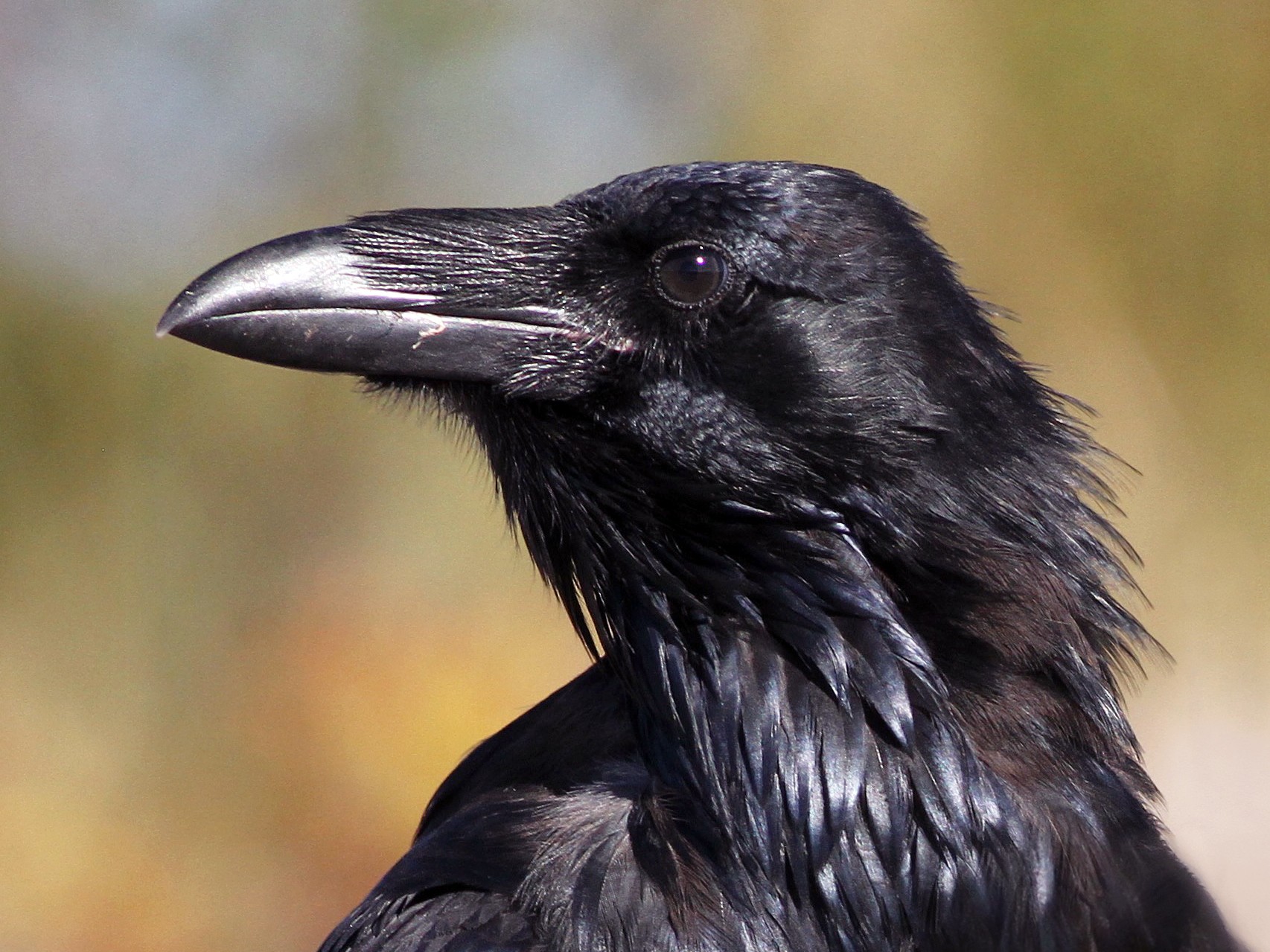
The Common Raven is much larger and heavier than the American Crow. It has a thick bill, a shaggy throat, and a long tail that often looks wedge-shaped in flight. An American Crow has a smaller bill, a less shaggy throat, and a tail that usually appears more rounded or fan-shaped.
Calls provide another useful clue. A raven often gives a deep, rough croak, while an American Crow is known for its familiar caw. Both species have a wider range of sounds than these simple descriptions suggest, so use calls together with body shape and behavior rather than relying on sound alone.
Flight style can also help. Ravens often soar and glide with long, broad wings, sometimes making impressive movements in the air. Crows may flap more steadily and are frequently seen in groups around neighborhoods, fields, and parks. These patterns are useful clues, not absolute rules.
Source: Bing
Body size
A raven is noticeably larger and bulkier than an American Crow when the birds can be compared at a similar distance.
Bill
Ravens have a heavier, thicker bill, while crows have a slimmer bill.
Throat feathers
A raven’s throat feathers can look shaggy or pointed, especially when it calls.
Tail shape
A raven often shows a longer, wedge-shaped tail in flight. A crow’s tail is generally more rounded.
Voice
Ravens often produce deep croaks, while American Crows commonly give a sharper caw.
What If You See Only One Large Black Bird?
Do not rush to identify it from size alone. Distance, camera angle, body posture, and the absence of a nearby bird for comparison can make a crow look larger than it is. Watch the bird for a few moments and note its bill, throat, tail, and call if you can hear it.
A photograph may help if the bird is too far away to judge in real time. Use a clear image of the whole bird rather than relying on a close crop of its head. A regional bird guide or a reputable identification resource can then help you compare the features.
Observe the tail
A clear view of the tail in flight can help separate a raven from a crow.
Listen for the call
Record the sound only if you can do so without disturbing the bird.
Check local records
Recent observations from your area can help establish which species is more likely.
Why Do Ravens Seem Rare in Some Places?
Ravens may seem rare because they do not occur at the same density in every landscape. Their presence depends on suitable nesting sites, access to food, local competition, disturbance, and the history of the population in that region. A species can be widespread across a continent and still be difficult to find in a particular county.
Human activity can have mixed effects. Ravens may benefit from food scraps, roadkill, landfills, and other food sources linked to people. At the same time, some kinds of habitat change, persecution, or disturbance can reduce local opportunities for nesting or feeding. The effect depends on the place and the type of activity.
Ravens also range widely while searching for food. A bird may pass through an area without staying there, so a brief sighting does not always mean a local population is present. In another location, the same species may use a reliable food source and appear regularly.
Weather and season can affect when ravens are easy to see. Birds may be more visible when they soar over open slopes, gather near a food source, or move through an area during changing conditions. However, there is no single season when ravens become rare everywhere in the United States.
Source: Bing
Habitat
A region with little suitable nesting or feeding habitat may support fewer ravens than a nearby mountain or open landscape.
Food availability
Ravens use many food sources, and local access to them can influence where birds gather.
Human disturbance
Repeated disturbance at a nesting site may affect whether ravens use it, although the impact varies by situation.
Local distribution
A species that is common in one state may be uncommon in another, so national range alone cannot predict a local encounter.
Identification errors
If observers record every large black bird as a raven, apparent local abundance may be overstated.
Can a Raven Be Rare Even if the Species Is Widespread?
Yes. A species can have a large overall range but be uncommon in certain parts of that range. This is why bird guides often distinguish the full distribution of a species from its local abundance and breeding status.
For example, a raven may be familiar to people who live near mountain cliffs in the West but unfamiliar to residents of a lowland neighborhood where crows dominate. Both observations can be accurate without implying that the bird is rare across the country.
National scale
Shows the broad geographic range of the species.
Regional scale
Shows where ravens are established or more frequently reported.
Local scale
Shows whether a specific park, neighborhood, or trail is a useful place to search.
What Is the Best Time to See a Raven?
Ravens can be seen throughout the year in many parts of the United States. The best time to look depends more on local bird activity and weather than on a universal calendar. Morning walks and late-afternoon outings can be useful because birds may be active while searching for food or moving between resting places.
Ravens do not follow one fixed schedule across all habitats. Local food supplies, breeding activity, weather, and disturbance can affect when they are visible. A raven soaring over a ridge in the afternoon may be easy to spot, while one feeding quietly in a wooded area may remain hidden.
Winter can provide good viewing in some regions because bare trees and open landscapes make large dark birds easier to notice. In other places, summer offers better access to mountain trails or coastal viewing sites. The season that works best depends on the local landscape and the weather.
If you want to increase your chances, choose a place where ravens are already reported, allow enough time to watch, and scan the sky as well as nearby trees. A short visit to an area with few ravens may produce nothing, even if the species is present in the wider region.
Source: Bing
Early morning
Watch open fields, ridges, and roadsides for birds moving out to forage.
Late afternoon
Scan high perches and open skies for birds returning to resting or roosting areas.
Winter
In some regions, reduced foliage can make ravens easier to see against the sky or in trees.
Breeding season
Ravens may spend more time near nesting territories, but nests should be observed from a respectful distance.
Are Ravens Harder to See in Summer?
Not always. Dense foliage can hide ravens when they perch in forests, but open mountain slopes, coastal areas, and deserts may offer clear views throughout the warmer months. Young birds and adults may also be visible while feeding or flying through open country.
Avoid assuming that a lack of sightings means the birds have left the region. They may be less visible, using a different feeding area, or moving at times when you are not outdoors.
Choose open viewpoints
Look for overlooks and clearings that let you scan the surrounding landscape.
Use your ears
A raven’s call may reveal its presence before the bird appears in view.
Repeat your visit
Several visits to a suitable site give you a better chance than relying on one brief stop.
How to Improve Your Chances of Spotting a Raven
The simplest way to find a raven is to start with a place where recent, reliable observations show that the species occurs. Choose a public trail, overlook, or other suitable viewing area, then spend time watching the sky, trees, and open ground. Patience is often more useful than traveling to a famous location without checking whether ravens are present.
Before leaving home, review a current range map or a bird-recording resource such as eBird. Recent records can show where observers have reported ravens, but they do not guarantee that a bird will appear during your visit. Sightings depend on effort, access, season, and the habits of individual birds.
Bring binoculars if you have them, and use a field guide or bird-identification app as a support rather than as a substitute for careful observation. Record the size, tail shape, bill, call, location, and behavior of any bird you suspect is a raven. Those details can help you confirm the sighting later.
Do not use food to lure wild ravens closer. Feeding wildlife can change natural behavior, draw birds toward roads, and create conflicts with people. You can observe ravens without baiting them or approaching nests.
Source: Bing
Step 1: Check the local range
Confirm that Common Ravens occur in your county or the wider area you plan to visit.
Step 2: Choose suitable habitat
Try mountain overlooks, open countryside, rocky areas, coastal sites, or known local observation points.
Step 3: Watch the whole landscape
Look above ridges, along tree lines, and around open ground rather than focusing only on nearby branches.
Step 4: Confirm the bird
Check its body size, bill, throat feathers, tail shape, flight, and call before labeling it a raven.
Step 5: Record the details
Write down the date, location, habitat, and identifying features to help review the sighting later.
What Should You Do If You Never See One?
First, check whether ravens are regularly reported in the area you chose. If there are few local records, try another site within the species’ known range instead of repeatedly searching a place that offers limited habitat.
Next, consider whether you may have overlooked a bird or mistaken a raven for a crow. A distant raven can look much like a crow, while a raven’s call may be unfamiliar to someone who has not heard one before. Reviewing photos and recordings from trusted bird-identification sources can improve your skills.
Finally, remember that wildlife viewing is never guaranteed. A quiet day does not mean your effort was wasted. You may learn about other local birds and return with a better idea of where and when to look.
Try a new location
Choose a site with recent raven observations and suitable habitat.
Allow more time
A longer visit gives you more chances to notice birds passing overhead or calling nearby.
Keep your distance
Do not approach a nest, pursue a bird, or enter restricted land to get a closer view.
Are Ravens Endangered or Threatened?
The Common Raven is not generally considered an endangered species in the United States. Its broad North American distribution and ability to use many habitats help distinguish it from species with very small ranges or highly specialized needs. However, the conservation status of a species does not tell you how many birds live in every local area.
Local populations can face challenges even when the species as a whole remains widespread. Habitat changes, direct persecution, disturbance near nests, and hazards linked to human activity may affect ravens in particular places. The nature and severity of these pressures vary by region.
Ravens may also benefit from some human-altered landscapes, especially where food is readily available. This flexibility does not mean that every human activity helps them or that local populations cannot decline. A careful assessment needs current regional evidence rather than a conclusion based only on how often people see the birds.
If you want to know whether ravens are uncommon or declining near your home, look for regional population information and recent bird records. A national range map is a useful starting point, but local conservation reports can offer a clearer picture of conditions in your area.
Widespread species
The Common Raven occupies a broad range across North America, including much of the United States.
Local differences
Regional abundance may differ because of habitat, food, disturbance, and population history.
Conservation evidence
Use current agency assessments and regional bird-monitoring records to evaluate local status.
Does Seeing More Ravens Mean Their Population Is Growing?
Not by itself. An increase in personal sightings can result from spending more time outdoors, visiting a new habitat, learning to identify ravens, or encountering a local food source. It does not prove that the overall population is increasing.
Population trends require repeated observations collected with methods that account for where, when, and how birds were counted. If you want to understand a trend, look for long-term monitoring or a regional wildlife assessment rather than relying on a handful of encounters.
Personal sightings
Useful for documenting where and when you saw a bird, but limited as a measure of population change.
Repeated surveys
Can help show whether local occurrence changes over time when the methods are consistent.
Regional assessments
Provide broader context about population status, conservation needs, and possible causes of change.
What Does a Raven Sighting Mean?
A raven sighting first means that a raven was present where you saw it. The bird may have been searching for food, traveling between feeding areas, defending a territory, or simply resting. Its behavior and the surrounding habitat provide more reliable clues than assumptions based on the bird’s dark color or reputation.
Ravens appear in many cultural stories and traditions, where they may represent wisdom, change, mystery, or a warning. These meanings can be important to individuals and communities, but they are cultural interpretations rather than scientific evidence that a bird predicts an event.
If a raven crosses your path, you do not need to assume that something unusual will happen. You can appreciate the encounter as an opportunity to observe a highly adaptable wild bird. Noticing how it flies, calls, and interacts with its surroundings can make the sighting meaningful without requiring a supernatural explanation.
A raven may also attract attention because people are more familiar with crows. Learning to identify it gives the encounter a practical value: you become better at noticing wildlife and understanding the birds that share your environment.
Biological explanation
The raven may be feeding, moving, resting, communicating, or responding to other animals.
Cultural interpretation
Different traditions attach different symbolic meanings to ravens, and those meanings vary.
Personal meaning
You may find the encounter memorable without treating it as a prediction or a sign of danger.
How Rare Is It to See a White Raven?
A white raven is far less typical than the familiar black Common Raven. White plumage may result from unusual pigment conditions, including leucism or albinism, but these conditions are not identical. Leucism can reduce pigment in some or all feathers, while albinism involves a genetic condition that affects melanin production and often affects the eyes as well.
A raven with white feathers should not automatically be called an albino. The appearance of the feathers and eyes, along with expert assessment, helps distinguish possible causes. Photographs alone may not provide enough information to establish the exact condition.
Reports of white ravens can attract wide attention because the appearance is unusual. However, the rarity of a particular color form is different from the conservation status of the species itself. A white raven is an unusual individual, not evidence that Common Ravens as a whole are rare.
If you see a pale raven, observe it from a distance and note the location, date, and visible features. A photograph taken without disturbing the bird may help experienced birders review the identification. Do not approach the bird or attempt to capture it because of its unusual appearance.
Leucism
A condition that can cause reduced pigment in some or many feathers while other pigmentation may remain.
Albinism
A genetic condition involving absent or greatly reduced melanin, often with effects on eye pigmentation.
Unusual appearance
A pale bird can be noteworthy without representing a separate raven species.
Frequently Asked Questions
Q
Is it unusual to see a raven in America?
It depends on where you are. Common Ravens are familiar in much of the western United States, Alaska, and many northern or mountainous areas. They may be much less familiar in regions where American Crows are more common. A sighting can be unusual for a person without being rare for the species.
Q
How many ravens are there in the United States?
There is no single current count that should be treated as an exact total for every raven in the United States. Population estimates depend on the survey method, the region covered, and the period measured. For a reliable population assessment, consult current bird-monitoring information from sources such as the U.S. Fish and Wildlife Service, state wildlife agencies, and established bird research organizations.
Q
Are ravens rarer than crows?
In many places, American Crows are easier to find, especially in towns, suburbs, and urban neighborhoods. Common Ravens are widespread too, particularly in Alaska and the West, but their local distribution differs. Whether ravens are rarer than crows depends on the region and habitat being compared.
Q
Can I attract ravens to my backyard?
You may notice ravens if your property lies within their local range and offers suitable habitat, but you should not try to attract them with food. Feeding wild birds can encourage dependence, create conflicts, and draw wildlife toward roads or people. Instead, observe birds from a distance and keep waste secured so it does not become an artificial food source.
Q
Are ravens active at night?
Common Ravens are mainly active during the day, although artificial lights, disturbance, or unusual circumstances may lead to occasional nighttime activity. If you hear a raven-like call at night, do not assume the sound came from a raven without further evidence. Other birds, mammals, and environmental sounds can be mistaken for a raven call in darkness.
Q
What should I do if I find a raven nest?
Watch from a respectful distance and avoid approaching, touching, or disturbing the nest. Do not climb toward a nest on a cliff or tree, and keep pets away if possible. If you believe a bird is injured or in immediate danger, contact a licensed wildlife rehabilitator or the appropriate local wildlife agency for guidance.
✦ Wrapping Up
Conclusion
How rare is it to see a raven? In much of the western United States, Alaska, and many northern or mountainous areas, it is not especially rare. In other regions, a raven may be an uncommon visitor, particularly where American Crows are the black birds people see most often. Your location, the habitat nearby, and your ability to identify the bird all shape your chances.
If you want to see a raven, start by checking recent local sightings and choosing suitable habitat. Look for a large bird with a heavy bill, shaggy throat feathers, broad wings, and a long, pointed tail. Give yourself time to watch, and remember that even a well-planned wildlife outing cannot guarantee an encounter.
💡 Key Takeaway
Check a current regional bird map or recent eBird sightings for Common Ravens near you, then visit a suitable public viewing area and observe birds without feeding or disturbing them.
Animal Facts Zone is a family-friendly online resource built for curious minds, students, and wildlife enthusiasts. Founded and edited by Sourov Biswas, the platform breaks down fascinating animal behaviors, species identification guides, and nature trivia into clear, easy-to-read articles.
From backyard butterflies and fireflies to reptiles, birds, and wild matchups, every guide is crafted to answer real questions about the natural world and inspire everyday wildlife appreciation. Whether you are a student researching a species or a nature lover exploring your own backyard, Animal Facts Zone helps you learn something new about the animal kingdom in minutes.